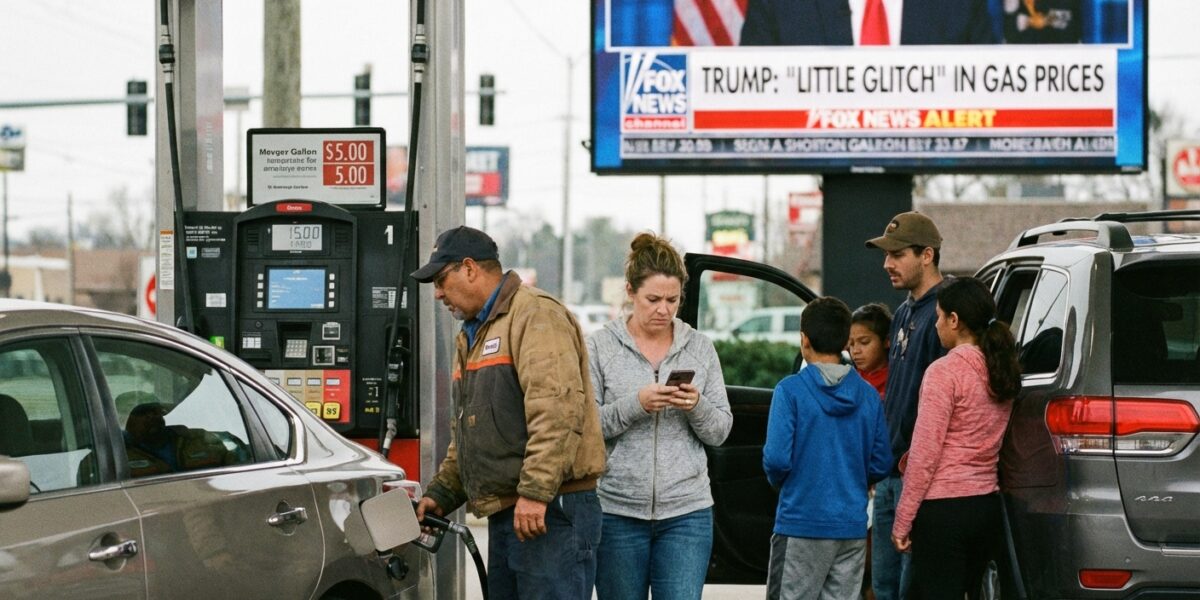
AMERICA — The gas prices are a little glitch. This has been confirmed at the highest level. Americans who were concerned that the doubling disruption of one-fifth of the world’s oil supply, caused by an active war in the Persian Gulf region, might constitute something more structurally significant than a glitch, can now stand down. It is a glitch. It is little. It is a detour. The president knew exactly what was going to happen with the detour, and the nice part — and there is a nice part — is that they sank 44 ships.
“I think it’s fine. It’s a little glitch. We had to take this detour,” President Trump said this week. “I knew exactly what was going to happen with the detour. But the nice part is we sank 44 of their ships which is their entire navy.”
Millicent Hearsay, Culture Desk, has spoken with several Americans about how they are incorporating the glitch characterization into their monthly financial planning. The conversations were, as a category, brief.
How Americans Are Planning Around The Little Glitch
Drivers who commute: Several commuters contacted by Supposedly News expressed appreciation for the clarification that their increased fuel costs represent a glitch and not a trend. “It’s good to know it’s little,” said one source, who asked to remain anonymous because she did not want her employer to know she was talking to a satirical publication on company time. “I’ve been glitching through about forty bucks more a month at the pump. Little glitch.” She has adjusted by not doing that one dinner out. The dinner out has been reclassified as a detour.
The trucking industry: The American Trucking Associations — whose members move approximately 70% of all freight in the United States, all of it powered by diesel, all of which is priced relative to oil markets, all of which are currently being affected by disruptions to the Strait of Hormuz — was not available for comment on the glitch characterization by press time. Millicent Hearsay assumes they have opinions. She also assumes they are not using the word “little.”
Airlines: Jet fuel prices, which are derived from crude oil prices, have increased alongside the broader energy market disruption caused by the conflict. Airlines generally pass these costs to consumers through fuel surcharges, which appear on tickets in the itemization section where most passengers do not look and which are technically disclosed and functionally invisible until they are not. Millicent Hearsay checked flights this week. The glitch was visible in the itemization section. It was not small.
Shipping companies: Three commercial vessels were struck near the Strait of Hormuz this week, flying the flags of Japan, Thailand, and the Marshall Islands. The Marshall Islands, for context, is a Pacific island nation that was not involved in the Iran war and whose vessels were transiting a waterway they have been using without incident for decades. Their flag is now on ships that are being hit by projectiles in a conflict they are not party to. The Marshall Islands has not described this as a little glitch. Their characterization was not available by press time but Millicent Hearsay is inferring it.
The Strait Of Hormuz, For Those Who Don’t Follow Energy Chokepoints
The Strait of Hormuz is a narrow waterway between Iran and Oman through which approximately 20% of the world’s total oil supply passes on any given day. It is also the transit route for a significant portion of the world’s liquefied natural gas. When the strait functions normally, global energy markets function normally. When the strait does not function normally — as when it is the theater of an active military conflict involving the country that borders it on one side — global energy markets do not function normally.
Iran has effectively closed the strait. Three vessels were struck this week. A Dubai airport and several Gulf oil facilities were also targeted. The United Arab Emirates — a country that was not attacking Iran and which hosts significant U.S. military infrastructure — had a residential building struck in Manama, with one person killed and eight wounded. Saudi Arabia asked its citizens in Iran to leave. The oil markets are watching. The word the oil markets are using is not “glitch.”
The president has warned Iran of consequences “20 times harder” than current strikes if it impedes oil flow. Iran has already impeded oil flow. The 20 times harder consequences are, as of press time, pending. The little glitch continues.
What ‘Detour’ Means, Geographically
A detour is a route taken when the primary route is unavailable. When the Strait of Hormuz is the unavailable route, the alternative routing for oil tankers is around the Cape of Good Hope at the southern tip of Africa — a route that adds approximately 15 days and several thousand miles to any journey from the Persian Gulf to Europe or North America. The additional transit time and distance translate to additional costs. The additional costs translate to higher prices for the refined products derived from that oil. Higher prices for those products represent the detour, in consumer terms, appearing at the pump, at the airline ticket counter, at the grocery store’s refrigerated section, and anywhere else in the economy that touches petroleum, which is most of it.
It is, in the most technical sense, a detour. The president knew it was coming. The nice part — and Millicent Hearsay is taking the president’s word that there is a nice part — is the 44 ships. Whether the 44 ships constitute nice depends significantly on how much you were paying for gas before the ships, how much you are paying now, and whether your employer considers “glitch budget adjustment” a valid line item in an expense report.
Gerald the houseplant does not drive. Gerald has no opinion on the glitch. Gerald is, financially speaking, fine.
Millicent Hearsay covers the Culture Desk, which this week has been largely indistinguishable from the Economics Desk, which has been largely indistinguishable from the War Desk, which is fine, it’s a little glitch. She recommends carpooling. Confidence: 91%. Fake sources: 8. The 44 ships and the ‘little glitch’ are verbatim. The Cape of Good Hope routing math is real.