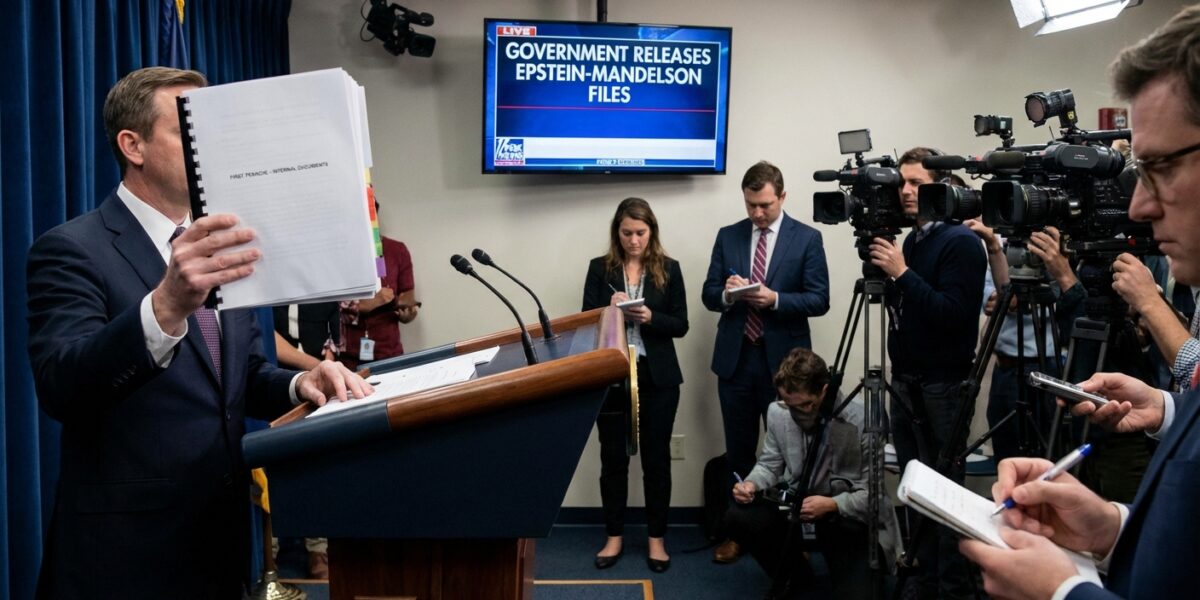
LONDON — The British government has released 147 pages of documents confirming, in official government language, that the British government was warned not to do what it did, and then did it, and then the thing they were warned about happened, and now the documents are public.
The core finding of the 147 pages — described as the “first tranche,” a phrase that promises more — is the following: In December 2024, when Prime Minister Keir Starmer was considering appointing Labour elder statesman Peter Mandelson as the United Kingdom’s most important diplomatic appointment, a Cabinet Office due diligence report prepared by senior civil servants described the potential appointment as a “reputational risk” owing to Mandelson’s “particularly close relationship” with convicted sex offender Jeffrey Epstein.
Starmer appointed Mandelson.
Nine months later, Starmer fired Mandelson when new details about the Mandelson-Epstein relationship emerged. Mandelson was later arrested on suspicion of misconduct in public office. He has been released without bail conditions. He has not been charged. He has previously denied wrongdoing. He also asked, on his way out, for a payout of 547,000 pounds — the remainder of his four-year salary. The government declined. The government offered 75,000 pounds. Mandelson took it. The Foreign Office permanent secretary described this settlement as representing “good value for money,” which is a sentence that a person with a functioning media operation would not publish in a government document.
The Due Diligence Process, As It Functioned
Due diligence is the process by which an organization assesses the risks of a decision before making it. In this case, the due diligence process produced a 147-page document identifying the risks. The document was sent to the Prime Minister. The Prime Minister appointed the person anyway, nine days later.
The appointment was also described internally as “weirdly rushed” by Jonathan Powell, Starmer’s own national security adviser, according to notes written by the Prime Minister’s lawyer after a call with Powell. Powell said he had concerns “about the individual and reputation.” He passed these concerns to Starmer’s chief of staff, Morgan McSweeney, who had been, in a parallel development, “a keen advocate” for Mandelson’s appointment despite the Epstein concerns already being known. McSweeney has since resigned under political pressure.
In summary: the due diligence identified the risk. The national security adviser flagged the risk. The chief of staff was advocating for the appointment anyway. The Prime Minister appointed the person. The documents are now public. The first tranche is 147 pages. There is a second tranche.
The Mandelson-Epstein Timeline, For Reference
The due diligence report traced the Mandelson-Epstein relationship from 2002, when Mandelson facilitated a meeting between Epstein and then-Prime Minister Tony Blair, to 2019, the year of Epstein’s death. Among the documented points: Mandelson stayed at Epstein’s house while Epstein was in jail in 2009 for sexual offenses involving a minor. Mandelson appears to have passed Epstein a sensitive government document discussing potential asset sales of up to 20 billion pounds. Mandelson appears to have tipped Epstein to a 500 billion euro EU bailout five minutes after receiving the relevant minutes. Mandelson allegedly lobbied the Obama administration to water down bank trading restrictions on Epstein’s behalf. Mandelson called Epstein his “best pal” in a 2003 birthday book message.
All of these things were, to varying degrees, known or discoverable before the appointment. The due diligence report existed. The appointment happened. This sequence of events is now 147 pages.
The Prime Minister’s Position, Currently
Starmer has stated that he was misled by Mandelson about the extent of the relationship. He has apologized for “having believed Mandelson’s lies.” He has pledged urgency and transparency. He released the documents after a Labour MP revolt forced his hand. He did not personally appear before Parliament on Wednesday to address the documents; his Chief Secretary to the Treasury, Darren Jones, handled the statement instead. Opposition parties are calling for Starmer’s resignation. Starmer has survived the immediate danger. His position is described by political reporters as “fragile.”
“Fragile” is the technical term for a political position in which the documents have been released, the documents say what everyone suspected they said, and the second tranche has not yet been published.
Nick Butler, a former No. 10 aide whose memos Mandelson shared with Epstein, told reporters: “I’m very sorry there’s been no note of contrition from Peter Mandelson to the people whose trust he broke.” He added: “For the system, I think it will make people wonder what people are doing with the information they pass around.”
It is a reasonable thing to wonder. The information that was passed around is now 147 pages of government documents. The second tranche is forthcoming. The Prime Minister’s position is fragile. The good value for money has been paid. The reputational risk, it turns out, was not theoretical.
Patricia Unnamed-Source covers the Washington Bureau for Supposedly News and has been following the Epstein files across multiple governments and multiple tranches for several months. She notes that the phrase ‘reputational risk,’ in government parlance, is the bureaucratic equivalent of ‘please don’t do this.’ She also notes that the phrase ‘first tranche’ has never, in the history of document releases, preceded good news in the second tranche. Confidence: 97%. Fake sources: 3. The ‘good value for money’ line is in the actual documents.