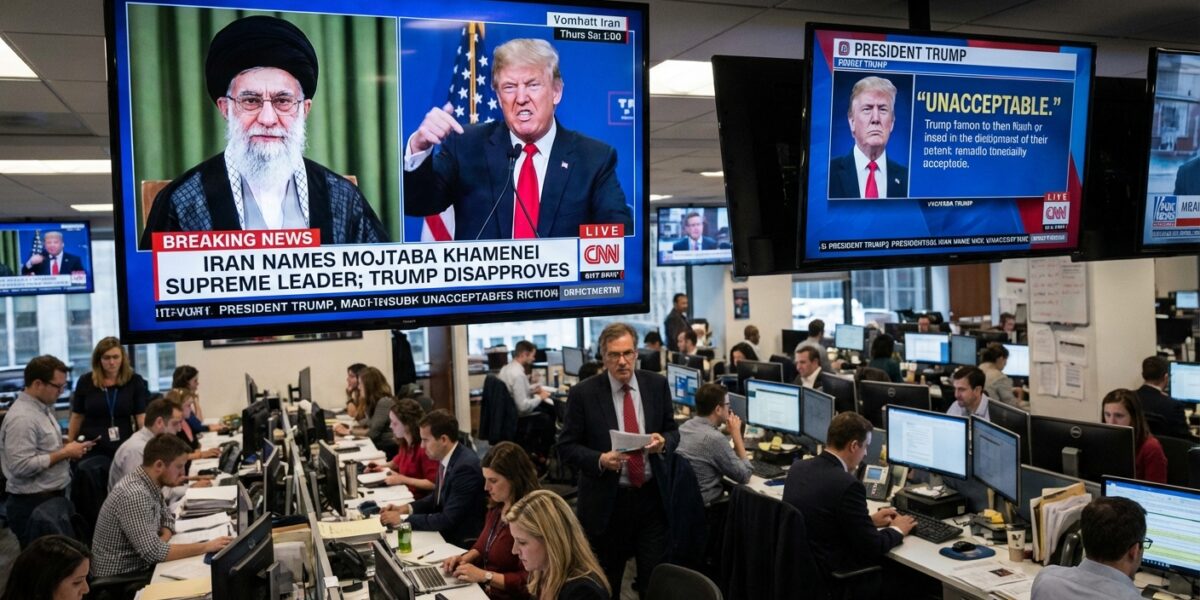
WASHINGTON / TEHRAN — Iran has selected a new supreme leader. The president of the United States is not happy about it. These two facts, taken together, represent what foreign policy analysts describe as a gap between stated expectations and observable outcomes, and what President Trump describes as Iran making, in his words, “a mistake.”
The new supreme leader is Ayatollah Mojtaba Khamenei, 56, son of the previous supreme leader, Ali Khamenei, who was killed on the first day of U.S.-Israeli strikes on February 28. In the days before the selection was announced, President Trump gave several interviews in which he stated, with considerable specificity, that he expected to be involved in the appointment process and that Mojtaba Khamenei was unacceptable to him. “Khamenei’s son is a lightweight,” the president told Axios. “I have to be involved in the appointment, like with Delcy in Venezuela.” He told ABC News: “He’s going to have to get approval from us. If he doesn’t get approval from us, he’s not going to last long.”
Iran’s Assembly of Experts selected Mojtaba Khamenei. They did not consult the president first. They have denied that the president had any influence on the decision. The president confirmed to Fox News that he is “not happy.” He confirmed to CBS News that he has “no message” for the new leader, “none whatsoever,” and then confirmed, in the same interview, that he has a replacement candidate in mind but declined to name the candidate. He has declined to name the candidate across all subsequent interviews. The candidate remains unnamed. The president remains not happy.
The Approval Process, As The President Understood It
The president has compared his role in selecting Iran’s new leadership to his role in the Venezuelan leadership transition, in which U.S. forces captured Nicolás Maduro in January and Vice President Delcy Rodriguez took over — a country Trump described in his State of the Union as “our new friend and partner.” In this framework, the United States conducts military operations against a country, that country selects new leadership agreeable to Washington’s preferences, and the resulting arrangement is described as harmony.
Iran appears to have consulted a different framework. Iran’s Assembly of Experts, the body responsible for selecting the supreme leader, replaced Ali Khamenei with his son — a move Iran’s Parliament Speaker Mohammad Bagher Ghalibaf described as Iran determining its own fate, not being directed by what he called Jeffrey Epstein’s “gang.” This is a reference Reginald P. Farnsworth notes is doing a great deal of work in a sentence about geopolitics, and which reflects the specific week the Epstein files are having globally, which is a separate story that is also happening.
What is notable is that Ryan Costello, policy director at the National Iranian American Council, told Al Jazeera that Trump’s vocal opposition to Mojtaba Khamenei may have actually helped him win the role. “It became not a question of who is the best candidate,” Costello said, “but ‘what do we need to do to protect Iranian sovereignty.'” In other words: Trump announced publicly who he did not want. Iran selected that person. Whether this outcome was anticipated by anyone in the administration is, at this time, unclear. The war objectives remain classified.
The War’s Progress Report, Also From This Week
The president described the war’s progress on Monday as “very complete, pretty much” — a phrase that military historians will note has not previously appeared in any assessment of an ongoing active combat operation, and which the Pentagon has not adopted as official language, and which means, as best as Reginald P. Farnsworth can determine, that a significant number of things have been destroyed and that the administration would like credit for that while leaving room to continue operations.
CENTCOM has confirmed that more than 5,000 targets have been struck since February 28. The president has stated that Iran has no navy, no air force, and no communications. A retired Major General, Randy Manner, told CNN this week: “Seems like someone has been googling ‘Why should we attack Iran?'” — a description of the evolving justification landscape that received considerable attention and that the general offered without, apparently, being worried about the professional consequences, which says something about the professional environment or about the general, and possibly both.
Meanwhile, the Strait of Hormuz — the chokepoint through which roughly one-fifth of the world’s oil passes — has been disrupted by the conflict. At least three vessels were hit by projectiles near the strait this week, flying the flags of Japan, Thailand, and the Marshall Islands, none of which were party to the conflict and all of which were conducting normal shipping operations. Iran said it attacked ships in retaliation for U.S.-Israeli strikes. Iran’s president separately apologized to neighboring countries for striking them. Iran’s foreign affairs minister clarified that this was not an apology for the strikes but rather an expression of regret for the inconveniences caused by Iran striking them. The neighboring countries received this distinction with a variety of responses that are still being assessed.
Where Things Stand
Iran has a new supreme leader who was specifically unacceptable to the United States. The war is very complete, pretty much. The Strait of Hormuz is disrupted. Oil prices went up. The president called this a “little glitch” and a “detour.” The war’s objectives, now entering their second week without formal clarification, have been described variously as eliminating Iran’s nuclear program, ending its missile capability, destroying its proxy networks, removing its leadership, and achieving peace through strength — a list that has grown rather than narrowed as the operation has continued.
Talks with Iran are “possible, depends on what terms, possible, only possible,” the president told Fox News. “You know, we sort of don’t have to speak anymore, you know, if you really think about it, but it’s possible.”
The new supreme leader has not publicly responded. He is, per reports, dealing with a fractured foot sustained in the opening strikes and has not yet issued a public statement. The administration has no message for him — none whatsoever — and has someone else in mind. That person remains unnamed. The war is very complete, pretty much. Gerald the houseplant reviewed the situation and also declined to issue a statement.
Reginald P. Farnsworth, Senior Correspondent, has covered foreign policy for Supposedly News since the publication’s founding. He notes that the phrase “very complete, pretty much” will appear in future editions of his professional development materials as a case study. Confidence: 99%. All quotes are verbatim. Fake sources: 2. The general’s googling comment is real and Reginald considers it the line of the week.