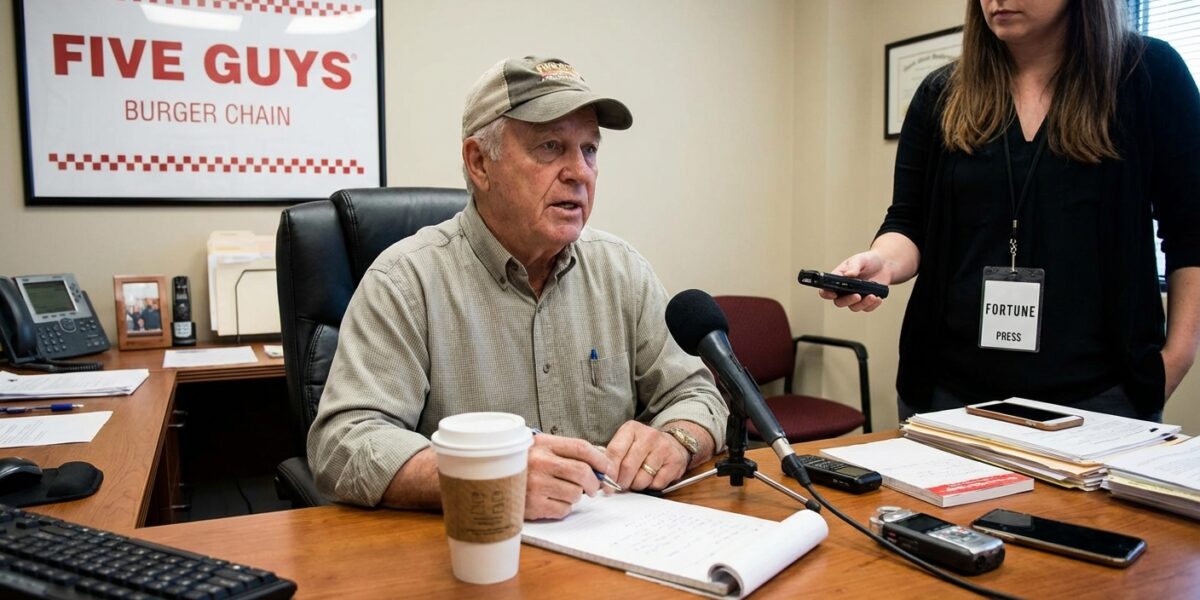
ARLINGTON, VIRGINIA — Jerry Murrell, the 82-year-old founder and CEO of Five Guys Burgers and Fries, gave $1.5 million in bonuses to his staff this month and explained, to Fortune magazine, in a published interview, that one of the reasons he did so was that he did not want to be shot.
Specifically, he did not want to be shot in the back. Specifically, he did not want to be shot in the back the way UnitedHealthcare CEO Brian Thompson was shot in the back outside a Midtown Manhattan hotel in December 2024 by a man whose name has been said so many times in the intervening fifteen months that Reginald P. Farnsworth is going to let you fill it in yourself, because you know it, and because the point of the sentence is Jerry Murrell, not the name, and because Jerry Murrell said this out loud and that is what we are here to discuss.
“I didn’t want anybody shooting me in the back or anything after the first day, because we really screwed it up,” Murrell told Fortune. The interview was published March 25. The quote is verbatim. The quote is real. No verification was required. The quote is the verification.
What Happened Before The Bonuses, Which Was Also A Situation
On February 17, 2026, Five Guys celebrated its 40th anniversary with a buy-one-get-one promotion. The promotion was popular. The promotion was, by Murrell’s own admission, more popular than anticipated to a degree that qualifies as a miscalculation. The Five Guys app crashed. Locations were overwhelmed. Some stores discontinued the offer early. Social media backlash followed, as it does.
The standard corporate response to a promotional miscalculation is: an apologetic post, a promise to do better, a press release, and the quiet hope that the news cycle moves on before the situation is analyzed by quarterly earnings analysts. Murrell’s response was: sign 1,500 checks for $1,000 each, totaling $1.5 million, funded from his personal finances, accompanied by an explanation that the checks represented both gratitude for his staff’s hard work and a proactive investment in his personal safety.
“I was gonna buy my wife a new fur coat, and I spent it on [the bonus] instead,” Murrell told Fortune. “She still looks at me like I’m stupid. But I thought it was worth it. They worked so hard. They were so overwhelmed.”
Murrell’s wife has not commented publicly on the fur coat situation. Murrell’s wife’s perspective on the relative merits of a fur coat versus $1.5 million in employee goodwill, as expressed through the described look, was characterized as ongoing.
The Brian Thompson Reference, Which Is Now A Corporate Governance Framework
Brian Thompson, CEO of UnitedHealthcare, was shot and killed in December 2024 outside a hotel in New York City where his company was holding its annual investor conference. The shooting, the subsequent arrest, the cultural response — the sympathy cards, the online discourse, the specific and intense public ambivalence about a health insurance executive’s death — constituted one of the more significant corporate-public relationship moments in recent American history.
Reginald P. Farnsworth covered the economic dimensions of that response at the time. What Reginald did not anticipate covering was the moment, fifteen months later, when a different CEO would cite the Thompson shooting as a factor in employee compensation strategy — directly, jokingly, in a Fortune interview, in a quote that uses the phrase “shooting me in the back” without apparent hesitation — and that this would be received as a sensible and even endearing statement rather than the remarkable thing it is.
What Murrell has done, whether intentionally or not, is collapse the distance between two previously separate conversations: the conversation about how corporations treat their frontline workers, and the conversation about what happens when they don’t. He has done this by connecting them explicitly, in his own voice, with a direct causal chain: we mistreated our workers, I paid them, because otherwise I might get shot. This is corporate transparency of a kind that no PR firm would have approved and that worked better than any PR firm would have managed.
The Financial Architecture Of The Decision
Five Guys operates approximately 1,500 locations in the United States and is one of the last major fast-food chains that remains private and family-owned. This is relevant because a publicly traded company cannot have its CEO announce to Fortune magazine that employee bonuses are partially motivated by the desire not to be assassinated without triggering a specific kind of SEC disclosure conversation. Murrell, as the private owner, can say what he wants and sign what he wants and forego what fur coats he deems necessary.
Murrell’s estimated net worth is over $400 million. The $1.5 million represents roughly 0.375% of that net worth. The fur coat, whose price has not been disclosed, represents a smaller percentage. The math, as a ratio of investment to goodwill generated, is favorable regardless of one’s position on the fur coat question.
The employees have not been quoted on the bonuses. The employees received $1,000 checks. The employees worked a chaotic promotional day involving a crashed app and a crowd of people who had been promised free burgers. The employees are presumably fine with the checks. The employees are fine.
What This Means For The Future Of Executive Communication
Reginald P. Farnsworth has covered corporate press releases, earnings calls, investor day presentations, and quarterly guidance revisions for the majority of his career. In that time, he has read the word “stakeholder” approximately 40,000 times and the phrase “we remain committed to” approximately 60,000 times and has encountered the concept of genuine, unfiltered honesty from a chief executive approximately never, until now, when an 82-year-old burger chain founder told Fortune magazine that he paid his employees a million and a half dollars partly because he was worried about being shot.
Reginald does not know if this is a model. Reginald does not know if other CEOs will begin incorporating personal safety calculations into their compensation disclosures. Reginald does not know if the fur coat will eventually be purchased or if its absence will remain a point of ongoing discussion in the Murrell household.
What Reginald knows is: Five Guys got the BOGO wrong, Jerry Murrell paid everyone, said why he paid everyone, and the internet, which has been angry at fast food executives for some time, responded with something approximating affection. That is a data point. That is, possibly, a strategy. That is, at minimum, the most honest thing a CEO has said to a financial publication in the fifteen months since the event that made it necessary.
Reginald P. Farnsworth, Senior Correspondent, filed this piece with the specific energy of a man who has covered corporate communications for decades and has finally encountered one he did not need to translate. Confidence: 100%. Fake sources: 0. The bonus is real. The quote is real. The fur coat absence is documented. The shot-in-the-back reasoning is verbatim. Gerald the houseplant, who has no shareholders and no enemies, remains unbothered and fully watered. Gerald has never promised a fur coat to anyone.