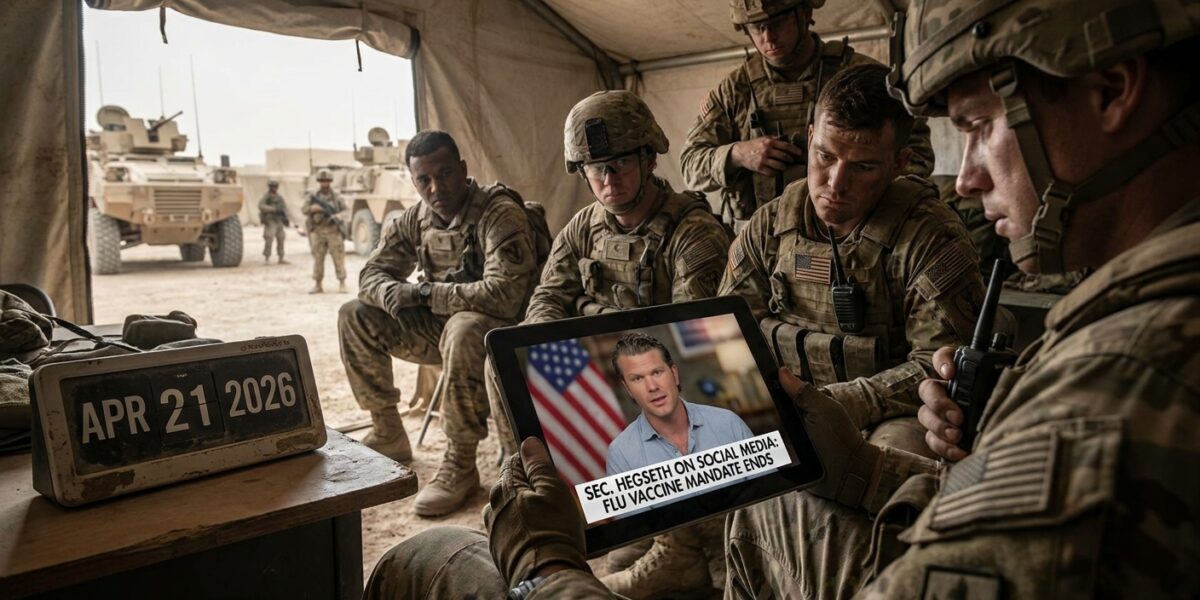
ARLINGTON, VIRGINIA — On Tuesday morning, the Secretary of Defense — who prefers to be called the Secretary of War, and whose department’s official website now resolves at war.gov, a URL that Reginald would like everyone to sit with before proceeding — posted a video to social media announcing that the United States military’s flu vaccine mandate has been ended, effective immediately.
The video was not accompanied by a formal Pentagon policy document. The Pentagon declined to share additional details about the policy, including its effective date, when contacted by USA TODAY. The announcement was made via social media video. The policy change affecting the medical readiness of approximately 1.3 million active-duty service members and 800,000 reserve personnel was communicated through the same medium one might use to announce a product launch or a restaurant recommendation.
Reginald is going to provide the timeline now. The timeline is the argument. Reginald will not editorialize until the end, at which point Reginald will editorialize anyway, because the timeline will have done the work and Reginald will merely be confirming what the timeline has already established.
The Timeline
1918: The influenza pandemic reaches U.S. military installations. Between 20% and 40% of all Army and Navy personnel fall ill. An estimated 26,000 U.S. soldiers die from influenza — not from combat, not from enemy action, but from a virus that moved through barracks and troopships and field hospitals with the efficiency of an adversary that understood close-quarters living better than any opposing general. The 1918 pandemic killed more American soldiers than the first year of the Korean War. It killed them in training camps before they reached the front. It killed them on transport ships in the middle of the Atlantic. It killed them in the specific conditions that military life produces: shared quarters, shared mess halls, shared air, shared everything.
1945: The U.S. military implements a mandatory flu vaccine for all service members. The mandate is established at the end of World War II, informed by the 1918 catastrophe and by the emerging understanding that biological threats — including influenza — represent a force readiness issue that commanders cannot afford to leave to individual choice. The vaccine is treated as force protection. The vaccine is treated as equipment. The vaccine is, in the military’s institutional logic, the same category of thing as a helmet or a flak jacket: something that keeps the force operational.
1949: The mandate is briefly withdrawn after researchers notice vaccine effectiveness declining. This is later determined to be caused by major antigenic shifts in the influenza virus — the virus changed, not the science.
Early 1950s: The mandate is reinstated after the viral changes become, in the language of the Wright State University analysis, “clearer and combatable.” The mandate remains in continuous effect from this point forward.
2020-2023: The COVID-19 pandemic produces a military vaccine mandate that becomes politically contentious. More than 8,400 service members are discharged for refusing the COVID-19 vaccine. The discharge decisions become a durable grievance in conservative political discourse.
February 28, 2026: The United States launches Operation Epic Fury against Iran. American troops deploy to combat zones across the Middle East. The troops live in close quarters. The troops share barracks, mess facilities, and transport vehicles. The troops are in exactly the conditions that made the 1918 flu catastrophic.
April 21, 2026 (today): Secretary Hegseth announces, via social media video, that the flu vaccine mandate — in place for 81 years — is ended, effective immediately. He frames the decision as restoring “freedom and strength” to U.S. forces. He says: “Your body, your faith, your convictions are not negotiable.” He explicitly links the flu vaccine decision to the COVID-19 vaccine controversy: “You know what I’m talking about, what happened [with] COVID-19 and the vaccine. No more.”
Reginald would like everyone to note the date. Reginald would like everyone to note that the flu vaccine mandate was ended during Week 8 of an active war in which American service members are living in the exact conditions — close quarters, shared facilities, deployment stress, limited medical infrastructure — that make influenza a force readiness threat. The mandate that was created because influenza destroyed force readiness in 1918 has been ended during a war in which force readiness is the stated priority of the Department of War.
The Numbers For This Season, Which Are Current
The Centers for Disease Control and Prevention estimates that during the 2025-26 flu season — the season currently underway — there have been at least 31 million flu illnesses, 380,000 hospitalizations, and 23,000 deaths in the United States. Of those deaths, 143 have been among children, 85% of whom were not fully vaccinated against influenza.
Military compliance with the flu vaccine has historically exceeded 95% among health care personnel, compared to less than 75% among civilian health care workers. The military’s compliance rate is among the highest of any institutional population in the country. The mandate produced this compliance. The mandate has been removed.
Dr. Richard Riccardi, a professor at George Washington University who served 31 years on active duty in the U.S. Army as a nurse practitioner, responded: “In the military, vaccination is not political theater. It is force protection. Troops live and work in close quarters, where influenza can spread quickly and sideline otherwise healthy service members.”
Reginald notes that Dr. Riccardi used the phrase “not political theater.” Reginald notes that the policy change was announced via social media video. Reginald notes the gap between those two observations and will now move to the structural analysis.
The Language, Which Reginald Would Like To Examine
Secretary Hegseth said: “If you, an American warrior, entrusted to defend this nation, believe that the flu vaccine is in your best interest, then you are free to take it, you should. But we will not force you, because your body, your faith, your convictions are not negotiable.”
Reginald would like to note what the U.S. military does negotiate, routinely, with service members: where they live, when they sleep, what they eat, what they wear, when they can leave, whether they can grow facial hair, how short their hair must be, what medications they take, what physical fitness standards they must meet, whether they can consume alcohol and when, and — until this morning — which vaccines they receive. Military service is, by definition and by contract, the negotiation of personal autonomy in exchange for institutional purpose. The institution tells the individual what to do. The individual agreed to this arrangement by enlisting. The flu vaccine was part of that arrangement for 81 years.
The phrase “your body, your faith, your convictions are not negotiable” is a sentence that, applied consistently, would dismantle the entire structure of military discipline. It is not being applied consistently. It is being applied to the flu vaccine. The haircut remains mandatory. The physical fitness test remains mandatory. The seventeen other vaccines on the military immunization schedule — including anthrax, smallpox, tetanus, hepatitis A and B, measles, mumps, rubella, polio, and varicella — remain, as of this announcement, mandatory. The flu vaccine has been singled out. The flu vaccine has been singled out because of COVID. Secretary Hegseth said so explicitly. The flu vaccine is not COVID. The flu vaccine has been mandatory since 1945. COVID has existed since 2019. The flu vaccine mandate predates COVID by 75 years. The two have been linked by political association, not by medical or policy logic.
What war.gov Says About It
The Department of War — which is, again, the Department of Defense operating under a rebrand that has not been authorized by Congress — published the announcement on its website under the headline “Hegseth: Flu Vaccine Optional.” The URL is war.gov. The announcement appears on war.gov. The Department is at war. The troops are at war. The flu vaccine that was created to protect troops at war has been made optional by the Department at war, and the announcement is on the website whose URL is the word “war” followed by “.gov.”
Reginald P. Farnsworth would like to note that war.gov is a real URL that resolves to a real website that is the official online presence of the United States Department of Defense, renamed. Reginald would also like to note that somewhere in the federal government, a domain registrar approved this. Somewhere, a GS-13 or equivalent processed the paperwork to redirect defense.gov traffic to war.gov, and that person did their job, and the URL is now live, and the flu vaccine announcement is on it, and the Department at war has decided that the vaccine designed to keep troops ready for war is no longer required during a war.
Reginald promised to editorialize at the end. This is the end. The editorializing is: the timeline is the argument, and the argument is that a mandate implemented because 26,000 soldiers died of influenza has been removed during a war because a different vaccine — one that did not exist when the flu mandate was created — became politically controversial 75 years later, and the Secretary of War has resolved this by treating the two vaccines as the same issue, which they are not, and by announcing the resolution on social media, which is not how military medical policy has historically been communicated, and by framing the decision as freedom, which is a word that does a lot of work in this administration and does not always mean what the work requires.
The troops are at war. The flu is in season. The mandate is over. The timeline is 1918, 1945, 2026. The numbers are 26,000, then 23,000, then zero — the last being the number of flu vaccines that are now required for the people in closest quarters in the most concentrated living conditions in the American institutional landscape. Reginald has the timeline. The timeline is the argument. Reginald rests.
Reginald P. Farnsworth, Senior Correspondent, filed this piece on April 22, 2026, with a confidence level of 100% and zero fake sources, because every element is documented. The announcement is confirmed by ABC News, Fox News, Military Times, USA TODAY, and the Department of War’s own website at war.gov. Hegseth’s quotes are verbatim from the social media video. The 1918 flu statistics — 20-40% of Army and Navy personnel ill, 26,000 soldier deaths — are from a 2022 Wright State University/U.S. Air Force analysis cited by ABC News. The 2025-26 flu season statistics — 31 million illnesses, 380,000 hospitalizations, 23,000 deaths, 143 child deaths — are from the CDC. Dr. Richard Riccardi’s statement is from ABC News. The 95% military compliance rate is from ABC News. The 8,400 COVID-related discharges are from Fox News. The flu mandate history — 1945 implementation, 1949 withdrawal, early 1950s reinstatement — is from the Wright State University analysis. The Iran war began February 28, 2026. Patricia Unnamed-Source is watching the Strait. Reginald is watching the policy. Gerald the houseplant has not been vaccinated against influenza. Gerald is a plant. Plants do not contract influenza. Gerald’s immune system is not negotiable because Gerald does not have one. Gerald is fine.