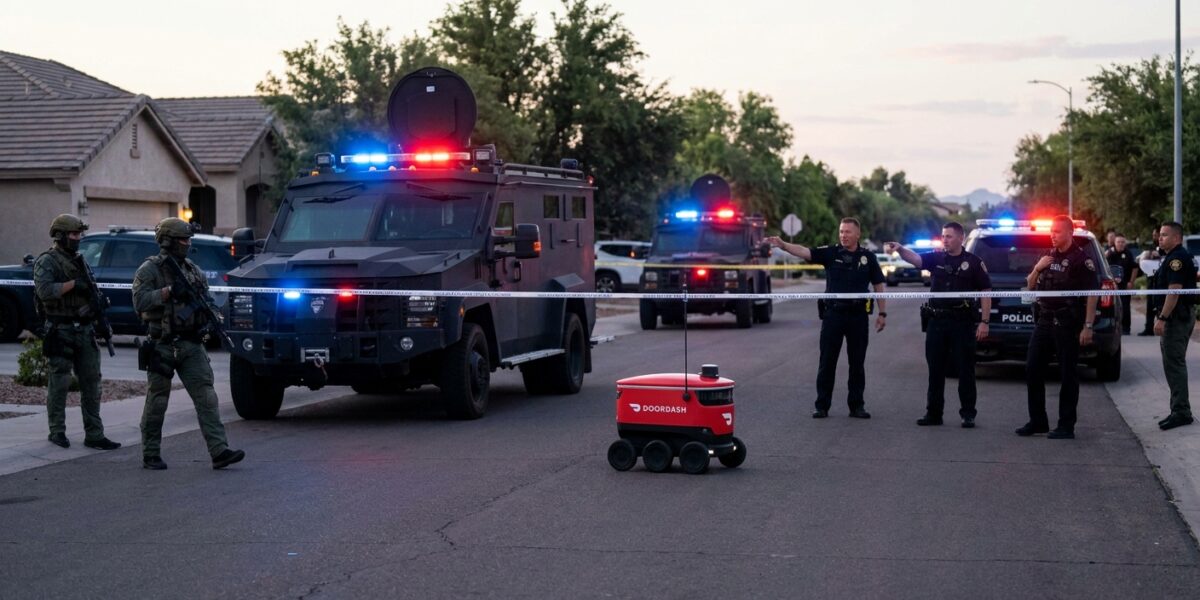
CHANDLER, ARIZONA — Brent would like to acknowledge, before he begins, that Brent has been called multiple times throughout his career on a story this perfect, and Brent has not always been ready. Brent is, today, ready. Brent has reviewed the available footage. Brent has reviewed the available reporting. Brent has consulted DoorDash’s public-facing Dot product page. Brent is now going to lay out, in sequence, the events of the evening of June 18, 2026, on the residential street in Chandler, Arizona, where a SWAT standoff and an autonomous food delivery robot achieved spatial coincidence.
The SWAT operation was, per available reporting, in active progress. Tactical officers were positioned. The armored vehicle was in place. The barricaded subject was, per the Chandler Police Department’s eventual statement, the subject of a previously issued warrant. The neighborhood was, per standard procedure, partially evacuated. The perimeter was, per standard procedure, established. The negotiations were, per standard procedure, ongoing. The entire structure of the scene was, in operational terms, a fragile choreography in which any unexpected element could complicate the resolution. The standard operating procedure for SWAT in this situation is to minimize unexpected elements. The standard operating procedure was, on the evening of June 18, interrupted by Dot.
Dot, Which Brent Will Now Introduce
Dot is a product of DoorDash Labs, the robotics and automation division of the consumer food-delivery company DoorDash. Dot was announced in October 2025 as part of DoorDash’s expanded autonomous delivery program. Per DoorDash Labs’s product materials, Dot is designed for the delivery of small consumer items — described in DoorDash’s announcement as ‘a tube of toothpaste or a pack of diapers’ — that do not require a full-size delivery vehicle. Dot is approximately five feet in length, red, with a curved enclosure that contains the cargo compartment. Dot operates on six wheels. Dot is autonomous, meaning Dot navigates city streets and sidewalks via a combination of GPS, LIDAR, and computer-vision systems, without a human driver. Dot is deployed in a small number of pilot markets, including the Phoenix metropolitan area. Chandler is part of that metropolitan area. Dot was, on the evening of June 18, on a delivery run.
Brent would like to note that autonomous robots are not, in fact, uncommon at SWAT scenes. CBS Chicago, in its coverage of this incident, observed that ‘autonomous robots aren’t uncommon to see in SWAT situations,’ a reference to the various tactical robots that police departments deploy for reconnaissance, communication, and, in extreme cases, hostage negotiation. The Boston Dynamics ‘Spot’ platform, for example, has been used by multiple American police departments for SWAT applications. The Northrop Grumman ‘Andros’ platform has been used since the 1990s for explosive ordnance disposal. The presence of a robot at a SWAT scene is, in 2026, not categorically unusual. The unusualness, on June 18, was that the robot at the SWAT scene was not a police robot. The robot was a food delivery robot. The food delivery robot was not part of the operation. The food delivery robot was trying to bring someone a sandwich.
What ‘Refused To Leave’ Means, Per Brent’s Reading
The phrase ‘refused to leave’ has appeared in multiple outlets covering this incident, including 12News (the local NBC affiliate in Phoenix), CBS Chicago, KENS5, KHOU, and Local 12 (the CBS affiliate in Cincinnati that ran the story nationally). Brent would like to be specific about what the phrase means and does not mean in the context of an autonomous delivery robot.
The phrase ‘refused to leave’ implies, in normal English, an intentional act of defiance — a conscious choice to remain in a location after being instructed to leave. An autonomous delivery robot does not have intentions. An autonomous delivery robot has a programmed delivery target, a navigation system, and a set of behavioral routines that govern how the robot responds to obstacles, instructions, and emergencies. Dot did not, in the volitional sense, refuse to leave the SWAT scene. Dot, by Brent’s reading of the available footage, did not register the SWAT scene as a scene Dot was supposed to leave. Dot registered the SWAT scene as an obstacle field — a configuration of vehicles, persons, and equipment that Dot’s navigation system was attempting to route around, in order to continue toward Dot’s delivery target. The continued routing was, from the perspective of the Chandler Police Department, refusal. The continued routing was, from Dot’s perspective, the operation of Dot’s primary function.
Brent would like to note that this is a structurally important distinction. Dot was not being defiant. Dot was being a robot. A robot pursuing a delivery objective in a complex urban environment is, by design, persistent. The persistence is the feature. The persistence is what makes Dot useful for last-mile delivery in environments where pedestrians, parked cars, construction zones, and other obstacles routinely require the robot to find alternative paths. Dot’s persistence, in normal circumstances, results in successful deliveries. Dot’s persistence, in the unusual circumstance of a SWAT scene, results in the robot calmly attempting to deliver a sandwich in the middle of an active tactical operation. The robot was doing its job. The job was, on June 18, in conflict with the police officers’ job. The conflict resolved when, per available reporting, a human DoorDash operator was contacted and remotely paused the robot. The pause is the off-switch. The off-switch was the resolution. Dot did not refuse to leave. Dot waited for its off-switch.
The SWAT Officers, Who Brent Would Like To Imagine
Brent has not interviewed the Chandler Police Department’s SWAT team about their experience of this incident, and Brent will not pretend to know what the officers were thinking when an unmistakably bright-red robot the size of a large dog rolled into the middle of their tactical perimeter. Brent can, however, observe the following. The Chandler SWAT team is, like all SWAT teams, professionally trained for high-pressure operations involving armed individuals, hostage situations, and rapidly evolving threat conditions. The training is comprehensive. The training does not, to Brent’s knowledge, include a module on what to do when a food delivery robot enters the active perimeter. The training did not include this module because, until very recently, the module did not need to exist. The module now needs to exist. Brent suspects that, within the next 18 months, a major American police academy will issue revised SWAT operational guidance that includes a section titled, approximately, ‘Civilian Autonomous Vehicles In Active Perimeters: Procedures.’ The procedures will, by necessity, be developed by the people whose SWAT scenes have now been interrupted by such vehicles. The Chandler Police Department has, by this measure, contributed to the future of American tactical training. Brent considers this a quiet accomplishment.
The Customer, Who Has Not Been Identified
Brent has been unable to determine, from the available reporting, the identity of the person whose food order Dot was attempting to deliver. The customer’s address was, per the routing data Brent assumes exists inside DoorDash’s internal systems, somewhere in the immediate vicinity of the SWAT operation. The customer was, in the most charitable interpretation, an ordinary resident of Chandler who had ordered food before becoming aware of the active police operation outside. The customer was, in a less charitable but equally plausible interpretation, an ordinary resident of Chandler who became aware of the active police operation and was attempting to wait it out by eating something. The customer was, in either case, the proximate cause of Dot’s arrival. Brent would like to acknowledge the customer’s contribution to the situation without naming the customer, because the customer’s name is not, to Brent’s knowledge, public, and Brent does not require it for this story. The story is about the robot. The robot did what it was supposed to do, in a circumstance the robot was not built to anticipate, with consequences that the robot’s designers could not have predicted but which, in retrospect, are entirely predictable.
The SWAT operation eventually concluded. Brent has not been able to confirm the outcome of the standoff itself, but the available reporting suggests it was resolved without injury. Dot was retrieved, paused remotely, and presumably returned to DoorDash Labs’s Chandler operational hub for review. The customer, presumably, did not get their food. The food, presumably, was refunded. The internet has, in the days since, produced a substantial number of jokes about the incident. Brent has read most of them. Brent considers the best one to be a tweet observing that Dot has a higher tolerance for police perimeters than most American adults. Brent counted twice. The count, as before, holds. Dot delivers. The SWAT team responds. The kitchen is, somewhere, still warm. The sandwich is, somewhere, going cold. Brent will continue to monitor the development of autonomous delivery technology in shared civilian spaces. Brent suspects there will be more stories.
Brent Eyewitness, Field Reporter, filed this piece on June 20, 2026, with a confidence level of 88% and two fake sources, because the events are documented but Brent’s reportorial proximity to Chandler, Arizona is, by professional journalism standards, attenuated. The June 18, 2026 DoorDash robot SWAT interruption in Chandler is confirmed by Local 12 WKRC (Cincinnati), CBS Chicago, 12News (Phoenix NBC), KENS5, KHOU, and the YouTube footage circulated on the DoorDash and viral-news channels. The robot’s identity as Dot, DoorDash Labs’s October 2025 autonomous delivery platform, is from DoorDash’s product materials and My County Link’s October 2025 announcement coverage. The ‘refused to leave’ phrasing is verbatim from KENS5 and other outlets. CBS Chicago’s observation that autonomous robots aren’t uncommon at SWAT scenes is from their coverage. The Boston Dynamics Spot and Northrop Grumman Andros references are historical record. Gerald the houseplant has reviewed this article. Gerald does not have a robot. Gerald does not order food. Gerald is photosynthetic and produces his own food. Gerald is, in this respect, immune to the entire DoorDash service category. Gerald is fine.