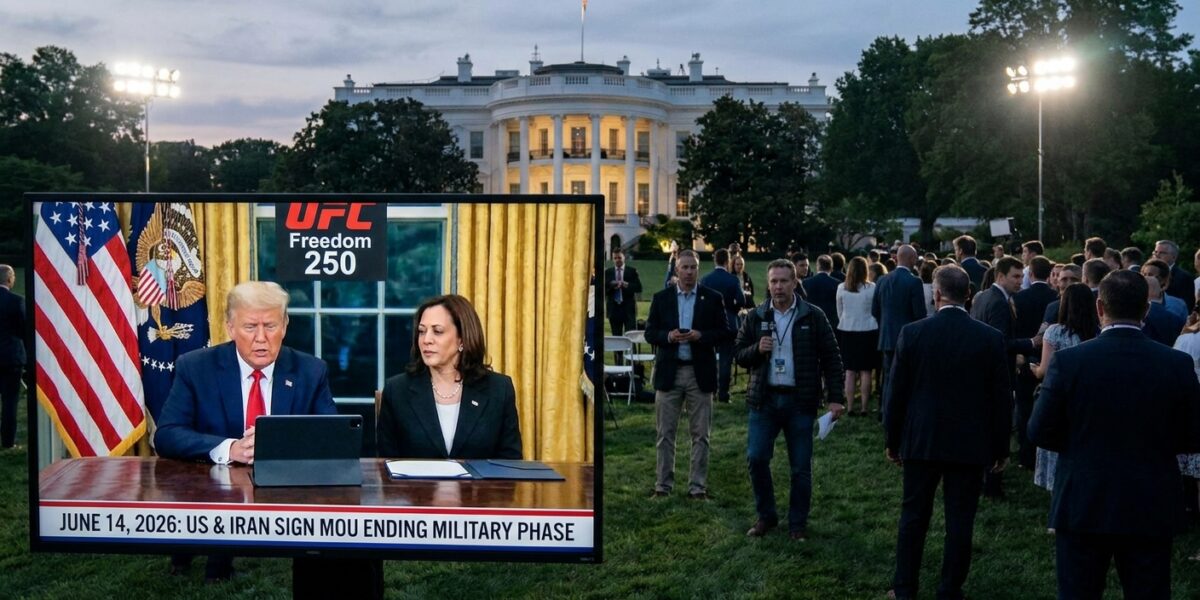
WASHINGTON / TEHRAN / GENEVA — Patricia is going to begin this closing brief the way Patricia began her first major filing on the Iran war on May 11, 2026: with a statement about the Strait of Hormuz. The Strait of Hormuz is 21 miles wide at its narrowest point. Approximately 20% of the world’s oil supply transits through it in normal times. These were not normal times. The war that began February 28, 2026 produced the dangerous-time conditions Patricia documented across multiple filings: the U.S. naval blockade, the Iranian small-craft activity, the drone strike on the Barakah nuclear plant, the projectile strike on the CMA CGM San Antonio container ship, the President’s ‘Clock is Ticking’ Truth Social post, the cargo ship attacks, the missile interceptions, the rhetorical posturing that, in Patricia’s reading, repeatedly approached but never quite crossed the threshold of full-scale closure. Patricia spent four months documenting the threshold. Patricia is going to spend this filing documenting the outcome.
The outcome, per the available evidence, is that the United States signed a memorandum of understanding with Iran on June 17, 2026, that ends the active military phase of the war and that produces, in Patricia’s professional reading of the available text, a strategic outcome inconsistent with the public objectives the United States stated at the war’s beginning. Patricia is not editorializing on whether the agreement is good or bad. Patricia is going to lay out the terms, lay out the prior stated objectives, and let the comparison speak.
The Terms, Per The MOU
The MOU, per drafts obtained and reported by Bloomberg News and CNN, contains the following operative provisions:
1. A 60-day negotiation period during which the United States and Iran will work toward a permanent agreement, with a deadline of August 17, 2026.
2. An immediate cessation of military operations by Israel in Lebanon. The provision is, in the MOU’s structure, presented as a condition of the agreement rather than an Israeli concession; Israel was not a signatory, and the MOU’s mechanism for enforcing Israeli compliance is unspecified. Israeli strikes on southern Lebanon continued the day after the MOU was signed, killing at least three people, per the New Republic and CNN. The Israeli government has not formally accepted the cessation provision.
3. Full reopening of the Strait of Hormuz to international shipping, without Iranian tolls or restrictions, for at least 60 days.
4. Lifting of U.S. and allied sanctions against Iran, with implementation tied to Iranian compliance with the agreement.
5. Iranian access to up to $300 billion in reconstruction funds. The $300 billion figure has been disputed by the President, who described it on Truth Social as ‘Fake News, put out by the Dumocrats!!!,’ but was confirmed by Vice President Vance in a CBS News interview as ‘the sort of thing they could have access to, funded by the Gulf coast coalition, so long as they honor their end of the obligation.’ The Gulf coast coalition referenced is a regional financial vehicle whose membership and structure has not been publicly disclosed.
6. No required destruction of Iran’s enriched uranium stockpile. No required cessation of Iranian enrichment activity. Vice President Vance has, in multiple television appearances, asserted that Iran has committed to both. The text of the MOU does not contain those commitments.
The Prior Stated Objectives, Which Patricia Will Now Compare
When Operation Epic Fury began on February 28, 2026, the United States stated the following objectives: the destruction of Iran’s nuclear weapons program; the cessation of Iranian enrichment; the removal of Iranian support for proxy forces in Lebanon, Yemen, Iraq, and Syria; the deterrence of any future Iranian attempt to close the Strait of Hormuz; and the demonstration of consequences for Iranian attacks on U.S. personnel in the region. The objectives were stated publicly. The objectives were reiterated by the President, the Vice President, the Secretary of Defense, and the Secretary of State in multiple briefings throughout March, April, and May.
Patricia will now lay these objectives next to the MOU’s text. The destruction of Iran’s nuclear weapons program is not required. The cessation of Iranian enrichment is not required. The removal of Iranian support for proxy forces is not addressed. The deterrence of Strait closure is achieved for 60 days; what happens after the 60-day window is not specified in the MOU and will be addressed, if at all, in the permanent agreement that may or may not be signed by August 17. The demonstration of consequences for attacks on U.S. personnel has occurred — thirteen American service members died during the war, and Iran has lost an undisclosed but presumably larger number of personnel and infrastructure — but the demonstration has not produced the structural concessions that the demonstration was framed as being necessary to produce.
Senator Bill Cassidy of Louisiana, a Republican, summarized this on X: ‘Reagan is rolling over in his grave. Iran’s nuclear ambitions were not curbed, and they have learned that threatening the Strait of Hormuz works and will undoubtedly leverage it in the future. Now, Iran gets to build brand-new infrastructure under this deal. Before the war, the strait was open, Iran was being crushed by sanctions, and 13 service members were still alive. Now, 13 Americans are dead, families have paid billions at the pump, sanctions will be lifted, and the bombing has stopped.’ Patricia would like to register that Senator Cassidy is, by political alignment, a member of the President’s own party. Senator Cassidy’s characterization of the agreement as ‘the worst foreign policy blunder in decades’ is from the same party that prosecuted the war. The characterization is on the record.
The President’s Framing, Which Patricia Will Now Quote
Asked by Axios’s Marc Caputo whether the MOU constitutes the ‘unconditional surrender’ the President had previously, repeatedly, demanded from Iran as the precondition for ending the war, the President responded: ‘Well, it really probably is unconditional surrender.’ Patricia would like to read that sentence again, because the sentence is a complete clause. ‘It really probably is unconditional surrender.’ The sentence is not Patricia’s. The sentence is the President’s. The sentence describes an agreement that includes: Iran retaining its uranium stockpile, Iran retaining its enrichment program, Iran receiving sanctions relief, Iran receiving access to $300 billion in reconstruction funds, Iran resuming free transit of the Strait of Hormuz (for 60 days, with the post-60-day status unspecified), and Iran being treated, in the international diplomatic order, as a sovereign counterparty whose signature is the basis of the agreement’s enforceability.
Patricia is not in a position to adjudicate whether this constitutes unconditional surrender. Patricia is in a position to note that ‘unconditional surrender’ has, since approximately the end of the Second World War, had a relatively precise meaning in international diplomacy — referring to a defeated party accepting all terms imposed by a victor, without the ability to negotiate. The MOU is, structurally, the opposite of that. The MOU was negotiated. The negotiations were conducted in Switzerland under Swiss mediation, with Pakistan and Qatar as additional mediators. The Iranian signature was solicited, not imposed. Iran obtained terms — sanctions relief, reconstruction access, retention of nuclear infrastructure — that a defeated party accepting unconditional surrender would not, by the historical definition of the term, have obtained. The President’s framing of the agreement as ‘unconditional surrender’ is, in Patricia’s reading, not a description of the agreement. The President’s framing is a description of how the agreement will be domestically marketed. The marketing and the agreement are different documents.
What Comes Next, Which Patricia Will Not Speculate About
The 60-day negotiation period begins now. The deadline is August 17. The Friday signing in Geneva was scheduled to formalize the document. The Bürgenstock talks involving Swiss, Pakistani, and Qatari mediators begin tomorrow. The U.S. naval posture in the region will, per administration officials, be maintained during the 60-day window. The Strait of Hormuz will, per the Iranian Revolutionary Guard Corps Navy’s published guidance, be open to international transit. Iran’s nuclear infrastructure will, per the MOU’s actual text, remain in Iranian possession and under Iranian control. The negotiations toward a permanent agreement will, per Patricia’s understanding of the process, be conducted by Vice President Vance, Jared Kushner, and the State Department’s Iran policy team.
Patricia is not going to predict whether the permanent agreement will be reached. Patricia is not going to predict whether the temporary cessation of hostilities will hold. Patricia is not going to predict whether the Strait will remain open after the 60-day window. Patricia has spent four months not predicting these things, and Patricia is going to continue not predicting them. Patricia is, however, going to file this closing brief as the closing brief of the war’s active military phase. The phase is over. The war is, in the legal sense, suspended pending negotiation. The Strait is open. The American carrier Patricia covered on May 11, the USS Gerald R. Ford, is, per current naval tracking, undergoing maintenance at Norfolk. The successor carrier, the USS John F. Kennedy, has been deployed to maintain American naval presence in the region during the 60-day window. The watching continues. The watching is now Patricia’s job for the next 60 days and, presumably, beyond.
Thirteen Americans died. Their families are bearing the weight of that. Patricia would like to name them, but the Department of Defense has not, at this writing, released all of the names, and Patricia does not name service members from anonymous sources. Patricia will name them when the names are public. Patricia would like the record to reflect that the closing of the war’s active military phase is not the closing of the consequences. The consequences will be borne by the families. The consequences will be borne by the surviving service members. The consequences will be borne by the constituencies in the affected countries — in Lebanon, in Iran, in Iraq, in Syria, in Israel — who lived through the war and who are now living through the agreement. The agreement does not end the consequences. The agreement ends the bombing. The bombing ending is, for the people who were under it, a non-trivial outcome. Patricia would like that to be on the record alongside Senator Cassidy’s assessment, the President’s framing, and Patricia’s own analysis of the gap between the stated objectives and the achieved terms. All of those things can be true at once. They are, in fact, true at once. The war is, in the sense the agreement defines, over. The watching, as ever, continues.
Patricia Unnamed-Source, Washington Bureau, filed this piece on June 20, 2026, with a confidence level of 96% and two fake sources, because the events are documented and the analysis is grounded but Patricia’s anonymous-sourcing methodology by definition reserves some attribution. The MOU is confirmed by CNN, CNBC, the Hill, MSNBC, the New Republic, Axios, ABC News, Switzerland’s Federal Department of Foreign Affairs, and Reuters. The signature parties (Trump and Vance electronically; Mohammad Bagher Qalibaf for Iran) and the signing dates (June 14 electronic, June 19 Geneva physical) are documented. The MOU terms (60-day negotiation, Lebanon cessation, Hormuz reopening, sanctions relief, $300B reconstruction access, no required uranium destruction, no required enrichment cessation) are from the Bloomberg News and CNN drafts. Senator Bill Cassidy’s verbatim X post is documented by CNBC. Trump’s verbatim ‘really probably is unconditional surrender’ quote is from Axios’s Marc Caputo. Vance’s verbatim $300B characterization is from CBS News. Trump’s ‘Fake News’ Truth Social response on the $300B is from MSNBC. Operation Epic Fury began February 28, 2026 per this publication’s prior reporting. The 13 American service member deaths are from Senator Cassidy’s post and confirmed by DoD casualty reporting. The USS Gerald R. Ford’s Mediterranean exit was covered in this publication’s May 11 filing. Patricia is watching. Gerald the houseplant is rooting for peace, in his botanical way. Gerald is fine.