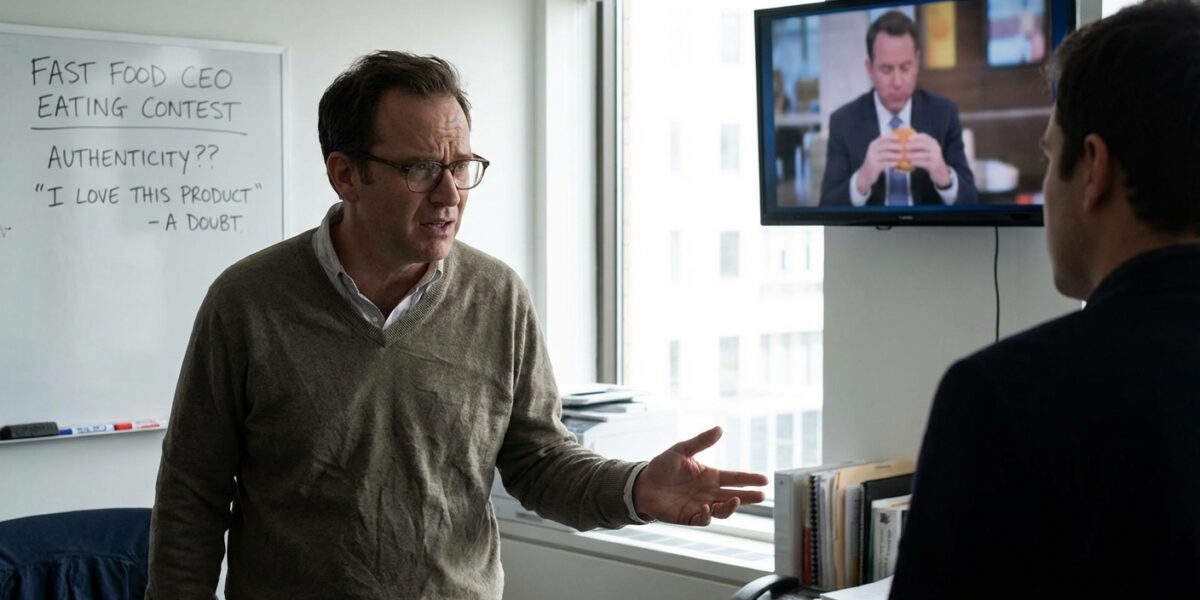
The fast food burger wars of 2026 have produced many things: memes, a Wendy’s job posting for Chief Tasting Officer with a $100,000 salary, a Ryanair tweet that was funnier than it had any business being, and the now-immortal image of McDonald’s CEO Chris Kempczinski holding a burger with the expression of a man attempting to defuse it.
They have not produced, as yet, anyone eating the burger on camera the way a normal person eats a burger.
This is the central paradox of the promotional food video: the closer to authentic human enjoyment the eating appears, the more the audience believes it; and yet the conditions under which the eating occurs — ring light, professional camera, corporate marketing objective, the ambient knowledge that this video will be reviewed by a communications team before posting — are precisely the conditions most hostile to authentic human enjoyment. You cannot eat a burger naturally while aware that four and a half million people are about to watch you do it. You can only attempt an approximation of naturalness, hope it lands, and pray that someone in post-production catches the grimace before it goes live.
Chris Kempczinski did not pray hard enough. Or someone in post-production had already gone home. Either way: the grimace went live. The bite was small. The word “product” was used with the frequency of a legal disclaimer. And the internet, which has very consistent opinions about authenticity and very inconsistent opinions about most other things, noticed immediately and responded at scale.
Tom Curtis Ate A Whopper And Everyone Loved It, Let Us Examine Why
Burger King president Tom Curtis posted a 13-second video of himself eating a Whopper. He took a full bite. He did not describe the bite as “a big bite.” He did not say “I love this product.” He did not exclaim “holy cow” upon seeing a burger, which is a food he presumably sees often given his profession. He simply ate the burger, appeared to be eating the burger in a way continuous with how a human person eats a burger, and the video ended.
The internet loved this video. The internet described it as refreshing. The internet held it up as an example of authenticity, of genuine enthusiasm, of a man who clearly eats Whoppers and wanted you to know it.
Douglas Allegedly would like to note: it is still a promotional video. Tom Curtis still works for Burger King. Tom Curtis taking that bite is still a calculated act designed to sell Whoppers, executed with the full knowledge of a communications team that had been watching the McDonald’s situation develop for several days and understood exactly what narrative would emerge from 13 seconds of confident burger consumption.
It was a very good 13 seconds. It achieved its goal completely. But it was not accidental sincerity. It was engineered sincerity, which is a different thing, and the fact that it felt authentic is evidence of how well it was engineered rather than evidence that no engineering occurred.
Burger King, as if anticipating this column, has confirmed that the video “was not created in reaction to anything.”
Douglas Allegedly believes Burger King’s spokesperson said this with a straight face. He believes this because he has covered corporate communications for long enough to know that the ability to say a sentence like that with a straight face is a professional qualification, not a character flaw.
Wendy’s Called It ‘Pretending’ And That’s The Word That Stuck
Wendy’s said: “This is what it looks like when you don’t have to pretend to like your ‘product.'”
That sentence is doing a lot of work. “Pretend” implies Kempczinski was performing an emotion he did not have, which is a meaningful allegation about a CEO’s relationship to his own company’s food. The scare quotes around “product” weaponize Kempczinski’s own vocabulary against him. The sentence does not mention McDonald’s by name. It does not need to. There is only one company that had the word “product” in its promotional burger video. Everyone knew who Wendy’s was talking about.
The question that interests Douglas Allegedly is: does Kempczinski actually not like the burger? Or does he like it fine but simply communicate the experience of liking it in the idiom of a quarterly earnings call rather than the idiom of a person enjoying food? These are different problems. One is a product problem. One is a communications problem. One suggests the company has food issues. The other suggests the company has executive coaching issues.
Douglas Allegedly, on the available evidence, believes it is the second problem. The burger appears to be fine. The burger has two patties, a signature sauce, crispy onions, pickles, and 1,020 calories. Food journalists who ate the whole thing reported it was a real hamburger that a real person could eat. Nothing in the product review record suggests the Big Arch is secretly unpleasant.
What the video record suggests is that Chris Kempczinski was put in front of a camera and given a burger and asked to be a human person on camera, and somewhere between the briefing and the bite, the human person receded and the shareholder presentation emerged, and nobody caught it in time.
What Should Happen Now
Kempczinski should, Douglas Allegedly believes, post a follow-up video. Not an apology — there is nothing to apologize for; a small bite is not a crime, and “product” is a real word — but a follow-up that demonstrates awareness. A video in which he eats the full burger. Names it correctly. Says something a person would say rather than something an earnings call would say. Accepts the roast gracefully. Finishes the lunch.
This will either rehabilitate the moment or generate a second viral cycle. Both outcomes sell burgers.
The Wendy’s Chief Tasting Officer job, meanwhile, remains open. The salary is $100,000. The qualifications are not specified. The ability to eat a full burger on camera without appearing to be afraid of it appears to be the primary competency being assessed.
Chris Kempczinski is not eligible. He has a conflict of interest. Also he already has a job, and that job comes with a significantly higher salary, and he should probably just finish the burger before worrying about the posting.
The burger is right there. It has been right there since February. Eat the burger, Chris.
That is Douglas Allegedly’s opinion. He stands by it. His confidence level in this opinion is higher than 12%, though he acknowledges the 12% was itself a joke and not a reflection of his actual confidence, which he assesses as “moderately high” and “not worth expressing numerically.”
Douglas Allegedly is Opinion Editor at Supposedly News. He has eaten McDonald’s food. He did not call it “the product.” He called it a cheeseburger. He would like this on the record.