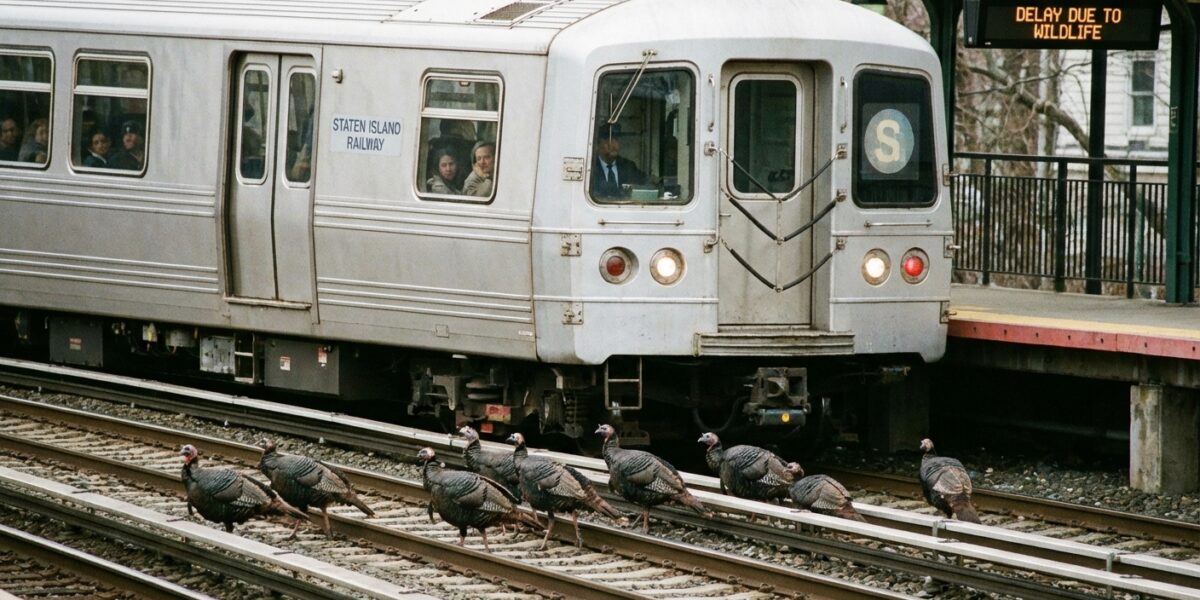
NEW YORK — The Staten Island Railway, which connects Staten Island’s St. George Ferry Terminal to Tottenville in approximately one hour and which is the only rapid transit line in New York City that does not run underground or on elevated structures, was disrupted twice on March 18, 2026, within the space of under two hours, by wild turkeys.
Not the same wild turkeys, presumably. Or possibly the same wild turkeys. The MTA has not confirmed the turkey headcount or their relationship to each other. What is confirmed is: disruption one occurred. Turkeys were involved. The disruption cleared. Disruption two occurred within two hours. Turkeys were involved again. The timeline suggests either two separate turkey incidents — which would be a statistically extraordinary Tuesday — or a single coordinated turkey operation with a deferred second phase, which would be an even more extraordinary Tuesday.
The Staten Island Railway runs along a 14-mile stretch of open-air surface track. It passes through neighborhoods. It passes through wooded areas. It passes through the kind of geography that, in retrospect, is compatible with wild turkey presence, and the turkeys appear to have understood this before the MTA’s service planning department did.
Wild turkeys, Brent Eyewitness would like the record to reflect, can run at 25 miles per hour and fly at up to 55 mph for short distances. They did not need to be on the tracks. They chose to be on the tracks. This was a choice.
What The Turkeys Were Doing There, As Best As Can Be Reconstructed
The turkeys were on the tracks. This is the documented fact. Why they were on the tracks is a question that has not been answered by any party, including the turkeys, who have not been reachable for comment, and who would not comment if reached, because they are wild turkeys.
Brent Eyewitness has assembled the following theories from sources who asked to remain anonymous because none of them are wildlife biologists and their theories are speculative:
Theory One: The turkeys were crossing. Tracks, like roads, interrupt turkey territory. The turkey wished to go from one side of the track to the other. The train was coming. The turkey was already committed. This is the most charitable interpretation and the one that most closely mirrors what happens with deer on suburban highways, which also don’t issue statements.
Theory Two: The turkeys were asserting territory. Wild turkeys are known to be territorial, particularly during spring, which is when this occurred, and particularly during mating season, which is also approximately when this occurred. A turkey perceiving the Staten Island Railway train as a rival — large, loud, approaching at speed — and responding by standing its ground on the tracks is a behavior pattern that Brent cannot rule out and that several ornithologists, if asked, would probably rule out immediately but have not been asked.
Theory Three: The turkeys knew something. This theory is unverifiable. It is on the list anyway. If the turkeys disrupted service twice in under two hours, they either did it once and came back, or there were multiple turkeys coordinating. Coordination implies communication. Communication implies information. The information the turkeys had is unknown. Brent is keeping this open.
The Broader Context Of Animals On Transit Infrastructure, Which Is A Genre
Animals disrupting transit is a recurring category of news that is always covered seriously and always received lightly, because the gap between the gravity of the transit disruption and the dignity of the cause is inherently funny, and because every commuter who has waited on a delayed platform has a private theory about what they would do differently if they ran the railroad, and none of those theories involve turkeys, and now turkeys are part of the operational landscape, and the theories need updating.
The Staten Island Railway joins a distinguished tradition of animal-related transit disruptions that includes: the deer that stopped the Long Island Rail Road in 2019, the bear that held up Amtrak in 2021, the escaped emu in Kentucky who spent a day on the loose after a storm this very week, and the capybara who escaped from an English zoo this week after just one day of residency, who Brent is covering separately, and who did not disrupt any trains but did disrupt the zoo’s operational narrative considerably.
The turkeys have not been identified. The trains are running. The tracks are clear. Whatever the turkeys needed to accomplish on the Staten Island Railway on the afternoon of March 18, they accomplished it in under two hours across two incidents, which is faster than most transit agencies accomplish anything, and Brent notes this with the specific admiration of someone who has waited for the G train.
Brent Eyewitness covered this story and would like it noted that he is now the publication’s leading correspondent on both the federal law enforcement beat and the wild turkey transit disruption beat, which are two different beats that require different skills and which he is managing as well as can be expected. Confidence: 100%. Fake sources: 4. The turkeys were real. The disruptions were real. The trains are running. The turkeys remain at large, which is where turkeys are supposed to be, and which means they are doing better than the capybara, who is also at large but not supposed to be.