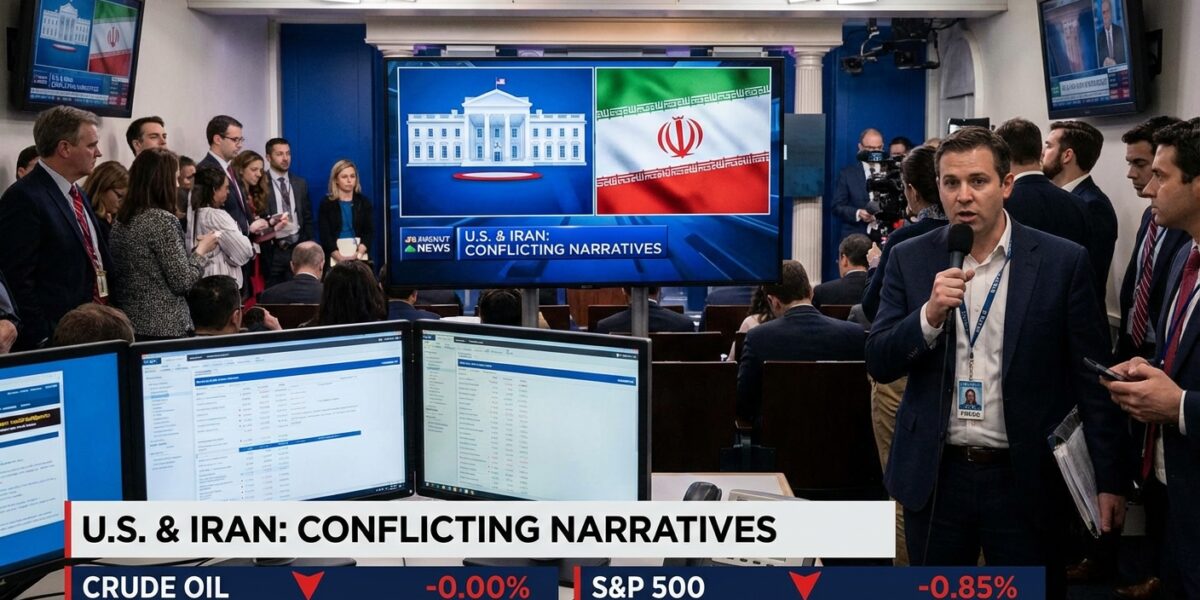
PALM BEACH / TEHRAN — The United States and Iran are either in very productive talks that could end the war within five days, or they are not talking at all and the claim is fake news, and both of these positions were stated on Monday by officials with the authority to state them, and both positions were stated as facts, and the oil market moved on the U.S. position, and then Iran’s position arrived, and the oil market moved again in the other direction, and both sides appear satisfied that they have accurately described what is happening, which means either the talks occurred and were not being disclosed by Iran for strategic reasons, or the talks did not occur and were being described by the U.S. for strategic reasons, or something in between occurred and both sides are describing their preferred version, and Patricia Unnamed-Source would like to know which of these it is but would also like it noted that she has been covering this war for twenty-four days and her tolerance for ambiguity has been considerably developed.
The specific claims, laid out precisely:
Trump: “We are now having really good discussions. They started last night, a little bit, the night before that. I think they’re very good. They want peace. They have agreed they won’t have a nuclear weapon.” Trump identified the American representatives as envoy Steve Witkoff and son-in-law Jared Kushner. He said the Iranian representative was “a top person” and “the most respected” — not the supreme leader — whom he declined to name because he “didn’t want to get him killed,” which is a sentence that contains several notable implications about the current state of talks and the safety of talking.
Iran’s Parliament Speaker Ghalibaf: “No negotiations have been held with the US. Fakenews [sic] is used to manipulate the financial and oil markets and escape the quagmire in which the US and Israel are trapped.”
Iran’s Foreign Ministry: No discussions have taken place. Tehran’s position on the Strait of Hormuz and conditions for ending the war have not changed.
Trump, asked about the Iranian denial: There is a “miscommunication” within the Iranian leadership. The people involved in the talks are not necessarily in contact with the people issuing denials. The talks went “perfectly.”
A source with knowledge of the discussions, per Axios: There does not appear to have been any direct talks yet between Iran’s parliament speaker and Trump’s team. Regional intermediaries — Egypt, Pakistan, Gulf states — have been relaying messages. An Israeli official told Axios that Washington had been in touch with the parliament speaker but was “surprised by how fast things were moving” and “did not know things were moving that fast,” which is the response of an ally who was told about the talks the same day as the press, which is a detail about alliance coordination that Patricia is filing for the record.
The Market’s Response, Which Had To Pick One
When Trump announced the productive talks on Monday morning, oil prices dropped sharply. Markets rallied. Wall Street posted strong gains. The possibility of de-escalation, if real, would reopen the Strait of Hormuz, reduce energy supply pressure, bring $103 Brent crude back toward a number that does not contain pi, and allow the phrase “little glitch” to be used retrospectively with somewhat more justification.
Then Iran denied the talks.
Then Iran launched missiles at Israel.
The missiles are the least ambiguous element of the day’s events. The missiles hit things. The things are in northern Israel. Buildings were damaged. People were injured. The missiles do not have a contradictory statement to issue. The missiles went where they went. The markets processed the missiles as they processed the denial: the oil that had gone down went back up. The rally that had rallied un-rallied to a degree. The market, which had to choose between “talks are happening” and “no talks are happening” as its operating assumption, is now functioning on the assumption that neither statement is complete and that the next five days will be clarifying, which is the same conclusion Patricia Unnamed-Source has reached, and she gets paid to reach it, and the market reached it faster.
The Five Days, Which Are Now The Unit Of Measurement
Trump has paused planned strikes on Iranian power plants for five days. This is the fifth deadline, fifth extension, fifth defined period since the war began twenty-four days ago. The previous defined periods were: “four to five weeks” (the original timeline estimate), “very complete, pretty much” (the day-fourteen assessment), the 48-hour Strait of Hormuz ultimatum that became a five-day pause, and now the current five days during which talks either are or are not occurring and could or could not produce a deal.
Five days is a specific amount of time. It is enough time for talks. It is not enough time to rebuild a war. It is enough time for Iran to fire more missiles, which it has already done. It is enough time for the markets to complete several additional full cycles of optimism and correction. It is enough time for Patricia Unnamed-Source to file at least three more articles, all of which she will title in a way that reflects the simultaneous existence of two contradictory official positions, because that is the environment and that is the job.
Iran’s Revolutionary Guard called Trump a “deceitful American president” and said his “contradictory behaviour will not make us lose sight of the battlefront.” The battlefront is still active. The talks are very good. The talks are not happening. The five days have started. Patricia is watching the clock. Gerald reviewed the situation. Gerald had no notes. Gerald’s confidence in the information environment is currently at 24%, which is the date, and which Patricia considers appropriate.
Patricia Unnamed-Source, Washington Bureau, has covered this story across twenty-four days and has now documented: the war’s start, the classified briefings, the evolving objectives, the Supreme Leader selection the president didn’t approve, the Kharg Island bombing, the treason threats against media, the Pearl Harbor joke, the talks that are happening, the talks that are not happening, and the five-day clock. She is taking notes. Confidence: 24% — the date. Fake sources: 9. The missiles were real. The markets moved. Both sides said what they said. Gerald had no notes. The five days have begun.