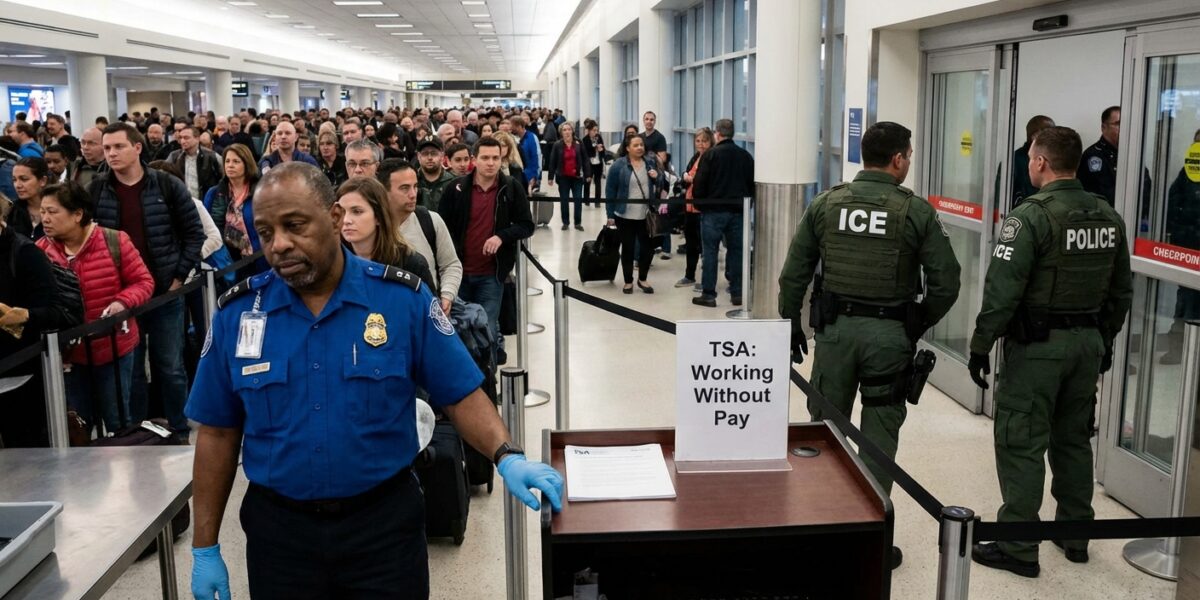
The partial government shutdown began February 14 when Congress failed to pass funding legislation for the Department of Homeland Security. It has been running for forty-three days. Forty-three days in, the consequences look like this:
Approximately 50,000 TSA officers — who are classified as essential workers and are legally required to report to duty — have been working without pay since February 14. More than 400 have quit. Thousands have called out sick, because when you have not been paid in forty-three days and you cannot afford gas or childcare or groceries, you make decisions about which obligations to prioritize, and the federal government has made the decision about whether it pays you in a way that informs those priorities. On Sunday, nearly 12 percent of TSA officers did not report for work — the highest absence rate since the shutdown began. At some airports, 40 percent of local staff called out.
The result: security lines three hours long at JFK, Atlanta, O’Hare, and Houston. A passenger at JFK who arrived at 4:45 a.m. for a 7 a.m. flight made it to his gate just in time for boarding. Two and a half hours. The TSA union’s description of morale: “Stress is at an all-time high. Morale is at an all-time low.” One TSA officer’s message to the reporters covering the deployment of paid ICE agents: “If you really want to help us, help us monetarily.”
The government’s solution, announced Monday by the president on social media and confirmed by Border Czar Tom Homan, is to send ICE agents to airports.
What ICE Agents Do, And What They Were Asked To Do Instead
Immigration and Customs Enforcement agents are trained to: identify, locate, and detain individuals who are in the United States in violation of immigration law. Their core competency is immigration enforcement. Their training covers immigration law, detention procedures, and the processing of individuals for potential deportation. They carry firearms. They have arrest authority. They are, in the language of their agency’s mission, “protecting America from the cross-border crime and illegal immigration that threaten national security and public safety.”
At the airports, they were asked to: guard exit doors, manage queues, and help move lines along.
Tom Homan told CNN they would be “helping TSA move those lines along, including by guarding exit doors to relieve TSA agents so they could screen travelers.” Officials confirmed the ICE agents will not carry out passenger screening. They will not replace TSA officers in the security function. They will guard the exits and stand near the lines.
The largest federal workers union described this as: “Does not fill a gap. It creates one.” The gap it creates is the gap between what ICE agents are trained to do and what they are being asked to do, which is a gap that can be bridged by a motivated person with a good attitude but cannot be bridged by training that does not exist, and which is a different gap than the one created by not paying the trained people, which is the original gap.
The Funding Situation, Which Is Why Both Things Are True At Once
Both ICE and TSA are part of the Department of Homeland Security. When the DHS funding bill failed, both agencies lost their appropriations — with one exception. ICE was separately funded by Trump’s 2025 “One Big Beautiful Bill,” which allocated approximately $75 billion for ICE over four years, including $30 billion for 10,000 new ICE employees, upgraded facilities, and operations.
TSA received no such separate funding. TSA is waiting for the DHS funding bill that Congress has not passed because Democrats demanded changes to immigration enforcement policies — specifically, that immigration agents clearly identify themselves and ban racial profiling — demands that arose after ICE officers fatally shot two U.S. citizens in Minneapolis in January. Republicans rejected the demands. Democrats rejected the Republican bill without the changes. Congress is now on a two-week recess without a deal.
The structure of the impasse, in simple terms: the agencies that enforce immigration policy are funded, the agencies that screen travelers are not, the impasse over funding the unfunded agencies is about immigration enforcement policy, and the solution to the unfunded agencies’ staffing crisis is to send the funded immigration enforcement agents to stand near the lines. This is a circle that closes in approximately one paragraph, and Douglas Allegedly wrote it in one paragraph, and the circle closes, and here it is.
What Trump Said About The Arrests
Trump told reporters that while ICE agents at airports could conduct immigration checks and make arrests, that was “not the primary reason” they were there. “They’re able to now arrest illegals as they come into the country. That’s very fertile territory. But that’s not why they’re there. They’re really there to help,” he said.
Douglas Allegedly notes that the phrase “very fertile territory” in the context of an airport security line — where international arrivals from dozens of countries are queued in a contained space, at a time when the trained security professionals are absent due to not being paid — is a description of the deployment’s secondary purpose that the administration confirmed while describing it as the non-primary purpose. Both the primary and secondary purposes are confirmed. The secondary purpose involves potential arrests of people in security lines at a time when the agents responsible for security lines are underpaid and calling out at a 12% rate. These are all documented facts about the same deployment. Douglas is filing them together and leaving the synthesis to the reader.
The Congress That Is On Recess
Congress is on a two-week recess. The shutdown is on its forty-third day. Airlines are asking Congress to pass funding. The Delta CEO said it’s “inexcusable.” Airline CEOs from Southwest, United, JetBlue, and others have written an open letter. The three-hour lines at JFK are documented by passengers who arrived before sunrise. The TSA workers are choosing between reporting to work and affording childcare.
Congress is on recess for two weeks.
Douglas Allegedly has no additional comment on this. The sentence contains its own commentary. The shutdown is forty-three days old. The recess is beginning. The ICE agents are at the exits. The TSA workers are without their second paycheck. The lines are three hours long. Congress will return in two weeks. In two weeks, it will be day fifty-seven.
Douglas Allegedly, Opinion Editor, filed this piece at the exact confidence level of 24% — the date — and notes that this is the most structurally complete circle he has documented for Supposedly News since the war objectives piece on day fourteen. The circle has a diameter equal to the funding gap. The circumference is everything in the three-hour line. The ratio is not pi. The ratio is $75 billion for ICE and zero for TSA and forty-three days. Fake sources: 4. Gerald the houseplant has never waited in a security line. Gerald does not travel. Gerald is, in this specific context, the most efficient person on the premises.