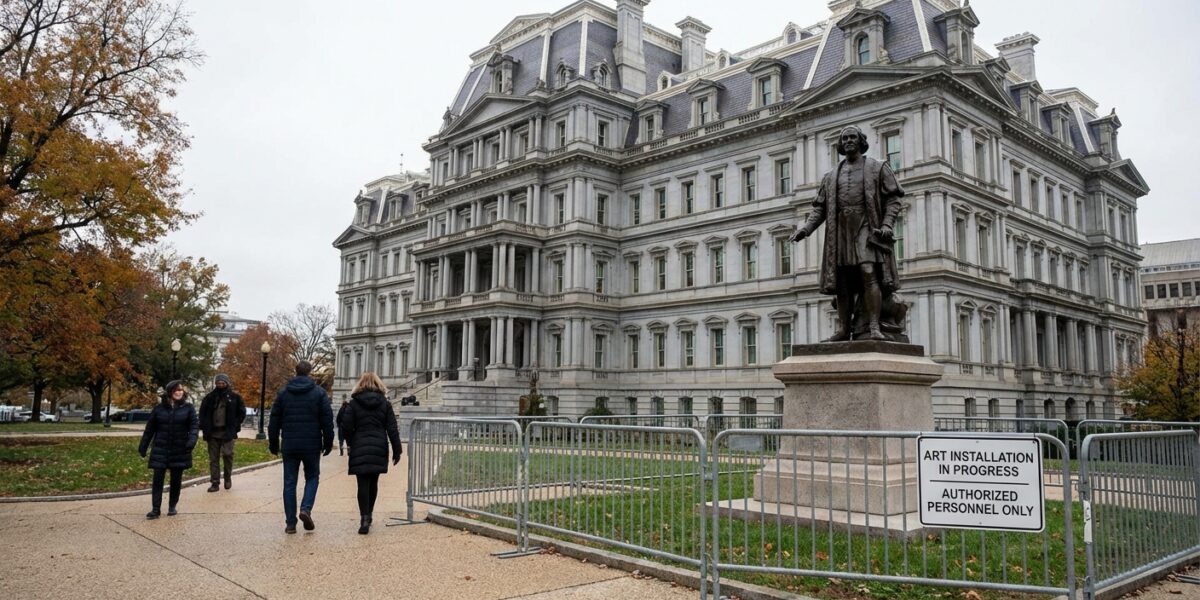
A statue of Christopher Columbus has been installed on the White House grounds. The statue is a replica of one that protesters toppled in 2020 in Richmond, Virginia. It now stands outside the Eisenhower Executive Office Building, which is where much of the executive branch’s administrative work occurs, and which is, architecturally speaking, a very large building that has been home to many confident decisions over the years.
Columbus sailed in 1492 with three ships, royal backing, and the conviction that he could reach Asia by sailing west. He did not reach Asia. He reached the Caribbean. He maintained, with considerable persistence and until the end of his life, that he had in fact reached Asia, or something close to Asia, or something that was at minimum consistent with his original description of where he was going. He never acknowledged that the landmass he had reached was not the one he set out for. He never revised his stated destination in light of the destination he arrived at. He died believing his original claim was substantially correct.
Reginald P. Farnsworth, Senior Correspondent, would like to state clearly that he is not drawing any specific contemporary parallels. He is presenting the historical record. He is noting that the historical record has been placed on the White House grounds. He is filing the proximity and leaving the synthesis to the reader, as he always does when the synthesis is sufficiently visible that it requires no further illumination.
The Statue’s History, Which Is Also The Story
The original Columbus statue in Richmond, Virginia was toppled by protesters in June 2020 during the nationwide reckoning with monuments to historical figures whose legacies include documented atrocities committed against Indigenous populations — Columbus specifically having enslaved, mutilated, and killed native peoples across the Caribbean in ways that are documented in the historical record, including in Columbus’s own journals, which he kept.
The statue was pulled down. It was stored. It has now been replicated and placed at the White House.
The White House’s statement framed the installation as a restoration of history — specifically the history of an explorer who, whatever else may be said, was the first European to establish sustained contact between Europe and the Americas, which changed the world, which is true, and which is one part of a history that also includes the other parts.
History contains all of it simultaneously. The statue, being a statue, contains whichever parts were selected for commemoration. Reginald notes that the selection is itself a decision, and that decisions made by people with authority tend to reflect the priorities of the people making them, and that this is true of all statues, everywhere, always, and is not a novel observation but is the correct one.
The Navigation Record, Examined In Full
Columbus’s navigational career features the following: a proposed route to Asia via westward Atlantic crossing; four voyages to the Caribbean and Central/South American coast between 1492 and 1504; a persistent belief that these landmasses were either Asia or adjacent to Asia; a refusal to update this belief when cartographers, sailors, and eventually the geographic consensus disagreed; and a posthumous legacy as the man who found a continent while looking for something else and called it found.
The continent found itself. Columbus named it incorrectly — the Americas were named after Amerigo Vespucci, who correctly identified the land as a continent previously unknown to Europeans. Columbus got the ships, the holiday, the statue, and the White House grounds. Vespucci got the hemispheres.
The week’s navigational parallels, which Reginald is still not drawing directly: a war whose objectives have been described variously as nuclear program elimination, naval destruction, regime change, not regime change, and “very complete, pretty much”; a set of talks that are simultaneously confirmed and denied; a five-day window within which a deal may or may not occur with a party that is also denying the deal is being negotiated; and an oil price that has traveled from a glitch to pi to a direction that is now unclear depending on which statement is the operative one.
Columbus arrived somewhere and called it where he was going. The statue is on the White House grounds. Reginald filed the juxtaposition. The reader can navigate from here.
What The Statue Looks Like, Because Culture Requires It
The statue stands outside the Eisenhower Executive Office Building. It depicts Columbus in the style of explorers’ statuary: resolute, forward-facing, the posture of a man with a destination in mind. The destination, as established, was not the one he reached. The statue does not depict the not-reaching. Statues rarely depict the not-reaching. The not-reaching is in the footnotes, and the footnotes are not on the statue, and the statue is on the White House grounds, and Reginald is filing all of this on a Monday in March 2026 when the news also includes the talks that are and are not happening and the security lines that are three hours long and the airport staffing crisis being addressed by the people trained for a different crisis.
It is a full day. Columbus would have understood a full day. Columbus had many of them. He called all of them successful. The definition of success was flexible. The statue does not reflect on this. The statue stands. Reginald filed the piece. Gerald the houseplant reviewed it. Gerald had no notes. Gerald, who has never navigated anywhere and has been in the same pot for two years, is perhaps the most honest presence in this story.
Reginald P. Farnsworth, Senior Correspondent, filed this piece on the 24th day of his coverage of a war that was estimated to last 4 to 5 weeks and has produced: major points of agreement that Iran denies, a security line crisis being managed by the wrong agency, and now a statue of a man who found a new world while insisting it was the old one. Confidence: 24%. Fake sources: 7. The historical record of Columbus’s voyages is documented. The statue installation is real. The Amerigo Vespucci footnote is real and has always been there. The reader may navigate from here.