On Good Friday, it is traditional to reflect on betrayal, on suffering borne without deserving it, on the distance between the sacred and the profane, and on what it means to invoke the name of Christ in service of something other than Christ.
This year, the material arrived pre-assembled.
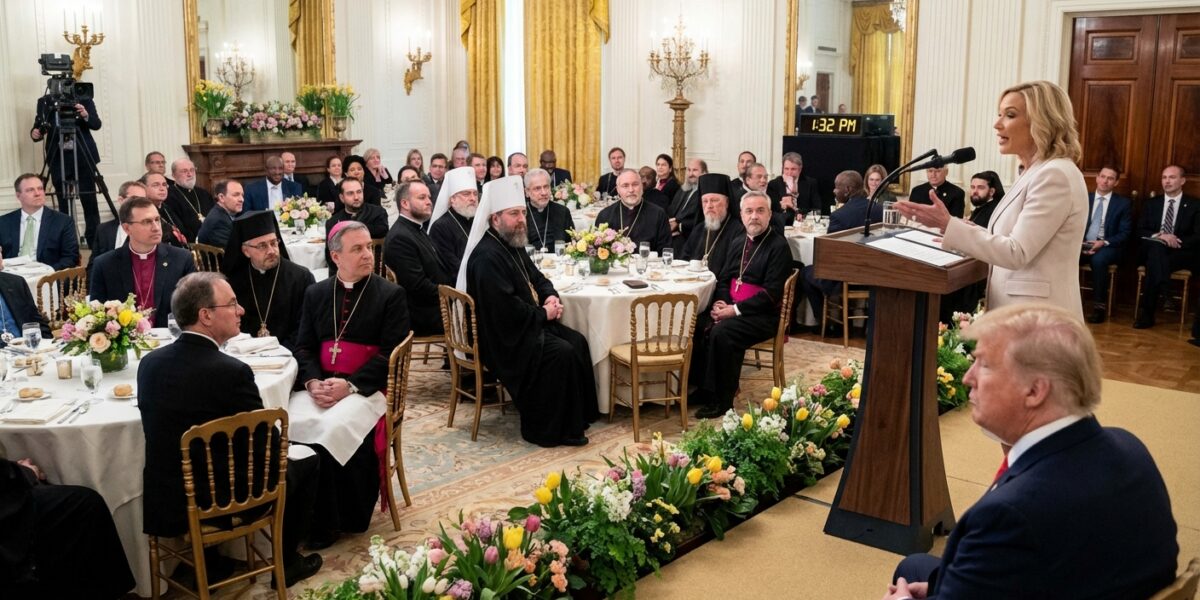
On April 1, 2026 — Good Friday falls April 3, Easter Sunday April 5, and the lunch at which this occurred was April 1, which is the actual date and not an editorial choice by Supposedly News — Paula White-Cain, director of the White House Faith Office, pastor, and longtime spiritual adviser to Donald Trump, stood in the East Room of the White House before more than one hundred assembled faith leaders, turned to face the President of the United States standing behind her, and said the following:
“Jesus taught so many lessons through His death, burial and resurrection. He showed us great leadership. Great transformation requires great sacrifice. And Mr. President, no one has paid the price like you have paid the price. It almost cost you your life. You were betrayed and arrested and falsely accused. It’s a familiar pattern that our Lord and Savior showed us. But it didn’t end there for Him — and it didn’t end there for you. And, sir, because of His resurrection, you rose up. Because He was victorious, you were victorious.”
Trump said “thank you.”
The White House posted the video to YouTube. Then the White House deleted the video from YouTube. The video, which had been intended as a closed press event, was then archived by Roll Call Factbase and clips were distributed widely by journalists who had already downloaded them, which means the deletion accomplished exactly what the deletion of a video on the internet always accomplishes, which is: nothing, and also now there is a story about the deletion.
Millicent Hearsay, Culture Desk, is filing this on Good Friday because Good Friday is the appropriate day for this particular reflection, and because the story broke on April 1 and Millicent did not want it filed on April 1, when it could be mistaken for the kind of thing Supposedly News fabricates on April Fools Day, which it did, and from which this is distinguished by: being real, being documented, and involving a government official comparing a sitting president to Jesus Christ at a taxpayer-funded Easter event from which the press was excluded, in front of a Catholic bishop who did not move.
The Comparison, Annotated By The Religious Community Itself
Millicent would like to be clear about who called this blasphemy. It was not secular critics. It was not the political left. The most sustained and specific condemnation came from within the Christian community — including from people who support Trump and from the traditions that White-Cain was invoking.
Catholic theologian Rich Raho called the remarks “blasphemous” and said: “It’s stunning to see a US Bishop standing right there on the stage while Paula White compares Trump to Jesus Christ.” The bishop in question, Robert Barron of the Diocese of Winona-Rochester — a member of the White House Religious Liberty Commission, a conservative Catholic intellectual who has written extensively on the Gospel — was onstage. He did not move. He did not speak. He was, in the technical theatrical sense, a witness.
Reverend Benjamin Cremer called the comments “blasphemy,” adding: “This is what it sounds like to take Jesus’ name in vain.”
Jesuit priest James Martin said White-Cain crossed a big line.
Evangelist Justin Peters said: “Powerfully blasphemous. And there stands one of the most prominent pastors in the SBC, Robert Jeffress, giving his unwavering endorsement to one of the most obvious false teachers ever to disgrace the name of Christ.”
Pro-life advocate and former NFL player Benjamin Watson said, with one word: “Heresy.”
Conservative commentator Erick Erickson, who is himself an evangelical Christian, said: “We got a group of men up there who don’t believe in having a woman in the pulpit taking orders from a woman in the pulpit twisting scripture in front of them, and they applaud.”
Millicent is listing these responses at length because they are the relevant theological verdict, and because the people issuing them are not opponents of the administration issuing them for political reasons. They are pastors, theologians, priests, and commentators who share the faith being invoked, and they used the words “blasphemous” and “heresy” with the specificity of people who understand what those words mean in the tradition they are defending.
The Theology, Which Millicent Is Going To Engage Briefly And Carefully
The comparison White-Cain drew has a specific structure. She identified three events from Jesus’s Passion narrative — betrayal, arrest, false accusation — and applied them to Trump’s political biography: the assassination attempt in Butler, Pennsylvania, the criminal indictment and arrest in Fulton County, Georgia. She then applied the resurrection — Christ rising from the dead on the third day, the central claim of Christian faith — to Trump’s political return to the White House.
The Passion and Resurrection are not, in Christian theology, a template for political success. The resurrection is not a metaphor for winning elections. The crucifixion is not a framework for evaluating criminal indictments. These are, within the tradition, specific events with specific theological meaning that are considered categorically different from anything that happens in a federal courthouse or on a Pennsylvania stage. Using them as rhetorical scaffolding for a political figure’s biography is not a matter of interpretation — it is, as multiple theologians stated publicly on the record, the definition of what their tradition calls taking the Lord’s name in vain.
White-Cain also said, in the same remarks: “I felt like I was conveying the heart of God for all of us, that we are thankful for the greatest champion of faith that we’ve ever seen in a president.” She said God told her to say these things. She said this in her official capacity as Director of the White House Faith Office — a government position, in a government building, at a government-organized event.
Millicent would like to note that the First Amendment’s Establishment Clause is about the separation of church and state, and that an official government event at which the government-employed director of the government’s faith office claims to be conveying the heart of God on behalf of the sitting president is operating in territory that several constitutional scholars would describe as worth examining, and that this is a separate question from the theological one, and that both questions were raised on the same day, and that the day was April 1.
Trump’s Own Contributions To The Event’s Tone
Before White-Cain spoke, Trump addressed the assembled faith leaders. He referenced Palm Sunday — the day Jesus entered Jerusalem to crowds waving palms, hailing him as king — and said: “They call me king now, can you believe it?” He then added: “No king — I’m such a king, I can’t get a ballroom approved,” which is a reference to his ongoing effort to construct a $400 million ballroom in the White House, which has encountered legal challenges, and which Millicent is including because the juxtaposition of Christ’s entry into Jerusalem and a $400 million ballroom permit dispute is doing something that Millicent cannot fully articulate but recognizes as a complete sentence about the current moment.
He also told the assembled faith leaders: “We know the feeling,” in reference to Jesus’s betrayal. White-Cain then formalized the comparison in her subsequent remarks. The Daily Beast reported that Trump’s expression changed from “stone-faced” to “a wide smirk” as White-Cain turned to look him in the eyes and began the comparison. He said “thank you” when she finished. The applause was described as substantial.
The Video Deletion, Which Is The Final Flourish
The White House posted the video. The video went viral. The White House deleted the video. The video was already archived. The clips were already circulating. The story about the deletion became its own story, because deleting a video that has already been distributed achieves nothing except demonstrating that whoever deleted it understood, after the fact, that what was on it required deletion.
Christian broadcaster Erick Erickson said: “Wow, that Paula White clip has burned through the Christian community in a not-good way. It’s no wonder the White House took down the video from YouTube.”
The video is gone from the White House’s own channel. It is not gone from the internet. It remains in the public record. The remarks are documented, verbatim, by multiple outlets. The Catholic bishop was there. The Baptist pastor Robert Jeffress was there. Franklin Graham was there. They all stood while it happened, and their presence was their endorsement, and their silence was their response, and both are in the record alongside the words.
What Millicent Is Thinking About On Good Friday
Good Friday is the day in the Christian calendar that commemorates the crucifixion. It is a day of solemnity, of stripping the altars, of dwelling in the space between death and resurrection. It is the day before Holy Saturday, which is the day of the tomb. Easter Sunday is the day after.
In the liturgical tradition, the story is told straight. The betrayal was Judas. The arrest was in Gethsemane. The false accusation was before Pilate. The crucifixion was on Golgotha. The resurrection was on the first day of the week, in a garden, with an empty tomb. It is a specific story with specific meaning that has been at the center of a specific faith for two thousand years.
On April 1, 2026, the Director of the White House Faith Office stood in the East Room and applied that story to the President of the United States, and the president said thank you, and the video was posted and then deleted, and the Catholic bishop was there and did not move, and theologians from across the tradition used the word blasphemy, and it is now Good Friday.
Millicent is not a theologian. Millicent covers culture. But Millicent has been covering culture long enough to know that when a story produces this particular configuration — uniform condemnation from the tradition being invoked, a deleted video, a smirking president, a silent bishop, and a day of the year that makes the juxtaposition impossible to ignore — the culture is trying to say something, and the job is to write it down clearly so the record reflects what happened.
What happened was: on the first day of April, in the year 2026, in the East Room of the White House, the government’s appointed keeper of the nation’s faith held up a mirror to the story Christians consider the most sacred in the world, and she pointed it at a man who said thank you.
Gerald the houseplant is in his terracotta pot. Gerald is oriented toward the light. Gerald has been there for two years and has never claimed to convey the heart of God. Gerald had notes on this article. Gerald’s notes said: this one writes itself. Gerald is not wrong. Gerald has been watered. Happy Easter.
Millicent Hearsay, Culture Desk, filed this piece on Good Friday, April 3, 2026, with a confidence level of 100% and zero fake sources. Paula White-Cain’s remarks are verbatim from footage archived by Roll Call Factbase, reported across The New Republic, The Christian Post, Newsweek, Fox News, The Daily Beast, and ChurchLeaders. Trump’s ‘they call me king’ and ‘thank you’ are documented by The Daily Beast. The White House deletion is documented. Bishop Barron’s presence and silence are documented by Rich Raho’s statement. All Christian leader responses are verbatim. Millicent wrote this straight. The story wrote it straighter.