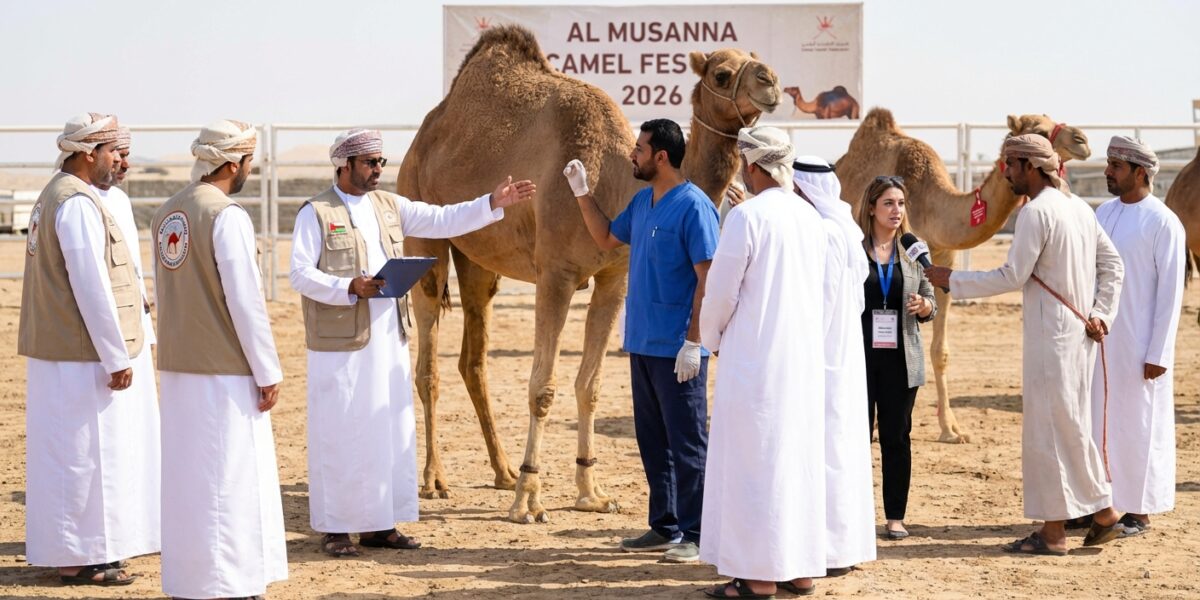
There are things that unite humanity across cultures and continents. A love of fairness. A commitment to honest competition. A belief that achievement should be the result of genuine excellence rather than artificial enhancement. And now, apparently, a recognition that cosmetic manipulation can penetrate even the camel beauty pageant circuit, where twenty competitors at the 2026 Camel Beauty Show Festival in Oman were disqualified after inspectors found that their humps had been injected with dermal fillers, their faces softened with injectables, and their lips made, in the official language of the festival’s report, “poutier.”
Poutier.
The camels were going for the pout. Someone decided they needed a bigger pout. Someone injected the pout. The inspectors found the pout. The pout was not natural. The pout was disqualifying.
Millicent Hearsay, who covers culture and has covered a great deal of it in the past three weeks, considers this the purest expression of a cultural phenomenon she has encountered in the job. Not because camel beauty pageants are unfamiliar — they have been part of Gulf culture for decades, celebrating the aesthetic qualities of camels that have defined Bedouin identity and livestock value for centuries — but because the specific arc of the scandal (artificial enhancement, detection, disqualification) is so precisely the same arc as every human beauty and athletic competition scandal that it raises a question Millicent is filing here: at what point did someone look at a camel and think, the hump needs work?
What The Camel Beauty Show Judges For, Because Context Matters
Camels are judged on: coat, neck, head, and humps. These are the official categories. The hump is a judged category. A larger, more symmetrical hump, in the tradition of Gulf camel aesthetics, is a more beautiful hump. A poutier lip is a more beautiful lip. A softer face is a more beautiful face. These are genuine and established aesthetic standards within the tradition, and within those standards, the temptation to give nature a small assist is, apparently, the same temptation that exists in every competitive environment where appearance is evaluated.
The camel did not ask for the filler. The camel has not been asked how it feels about the procedure or the disqualification. The camel’s feelings on the matter are unknown and will remain unknown. The manipulators — the humans who administered the fillers — will face “strict penalties,” per festival officials, which is appropriate, and which is more accountability than the humans who receive filler typically face, which is none, because human adults are allowed to make choices about their own faces, whereas the camel is not a consenting adult in the relevant sense and also cannot consent in any sense because it is a camel.
The Dermal Filler Industry’s Unexpected Market Expansion
Dermal fillers are substances — most commonly hyaluronic acid — injected into soft tissue to add volume, reduce the appearance of lines, or alter the shape of a feature. They are approved for human cosmetic use. They are used by millions of people annually. They are now, apparently, also available to competitive camels in the Gulf, which represents a market expansion that no cosmetic dermatologist’s five-year plan included but which several cosmetic dermatologists may now be quietly noting.
Millicent Hearsay reached out to a dermatologist for comment on the camel situation. The dermatologist, who asked not to be identified because they did not want to be associated with this article, said: “The physiology is different but the principle is the same. You’re adding volume to a soft tissue structure to achieve an aesthetic effect. Whether it holds the same way in a camel, I genuinely don’t know. I’ve never done a camel.”
The dermatologist added: “The lip thing tracks. Lips are lips.”
Millicent is filing this quote as the most efficient summary of the scandal available.
The Broader Implications, Which Millicent Sees Clearly
The camel Botox scandal joins a tradition of performance and appearance enhancement scandals across competitive arenas: doping in cycling, deflated footballs, corked bats, figure skating judging controversies, and now, dermal fillers in camel humps. Every competition eventually produces someone who decided that the rules were a framework for negotiation rather than compliance, and that the inspectors might not check the humps, and that a poutier lip was worth the risk.
The inspectors checked the humps.
The lesson, which is the same lesson that cycling and baseball and international figure skating have produced before it, is: they will check the humps. They always check the humps. The enforcement mechanism exists for exactly this reason, because someone always enhances the humps, and someone always checks, and the outcome is always the same: disqualification, strict penalties for manipulators, and, eventually, a satirical news article filed on a Sunday in March 2026 by a culture correspondent who has been covering a war and now has this, which she finds, genuinely, a relief.
Happy Sunday. The camels are beautiful. Some of them less artificially than others. The inspectors are on the case. The pout has been confiscated. Gerald the houseplant has no humps to enhance. Gerald is natural. Gerald is fine.
Millicent Hearsay, Culture Desk, filed this piece with the specific energy of someone who has been covering geopolitics for three weeks and was given a camel scandal and said yes. Confidence: 89%. Fake sources: 6. The camel festival is real. The dermal fillers are real. The poutier lips are documented. The strict penalties have been announced. The lip quote is from a real dermatologist who asked not to be named and said the lip thing tracks. Millicent agrees.