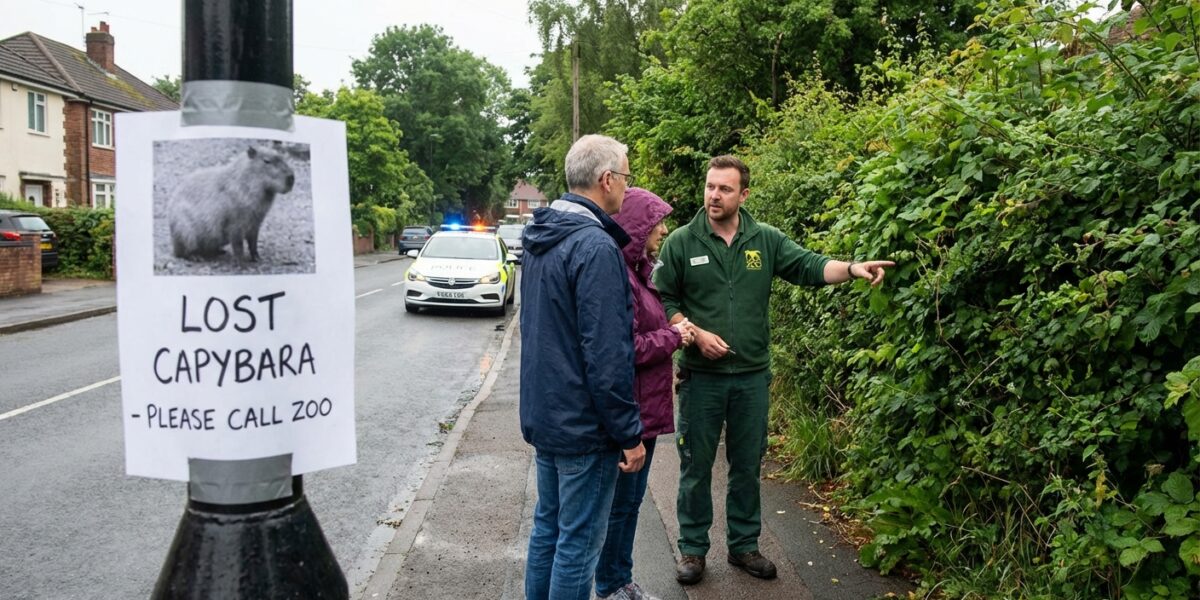
ENGLAND — The capybara had one day. It looked around. It made a decision.
A zoo in England — whose name has not been specified in available reporting, possibly because zoo management is hoping to limit the reputational damage of this timeline — received a new capybara resident and then, approximately twenty-four hours later, did not have a new capybara resident, because the capybara had escaped and is now in the English countryside, which is, Brent Eyewitness notes, where you end up when you decide on day one that the zoo is not for you.
The zoo has asked nearby residents to report sightings. The residents are presumably on alert. The capybara is presumably in a hedge. These are the current positions of the parties.
Brent Eyewitness would like to document the timeline, because the timeline is the whole story:
Day Zero: Capybara arrives at zoo. Is placed in enclosure. Is presumably shown the amenities. Water feature, presumably. Hay, presumably. Other animals at a distance. The enclosure has a perimeter. The perimeter is, in retrospect, insufficient.
Day One: Capybara is no longer in the enclosure. Capybara is in England.
That is the complete timeline. That is all of the time that was required. Twenty-four hours of assessment, a perimeter evaluation, a decision point, and a departure. The capybara did not wait to see if things improved. The capybara did not file a grievance. The capybara voted with its feet, which are semi-webbed and good for navigating English terrain, and was gone.
The Capybara, As An Animal, And Why This Is Consistent With Its Character
Capybaras are the world’s largest rodents. They are native to South America, where they inhabit rivers, wetlands, and grasslands. They are excellent swimmers. They are social animals who live in groups. They are, by all accounts, chill — the internet has embraced them as icons of unbothered energy, the animal equivalent of a person who sits in a hot tub while chaos unfolds around them and simply does not react.
The English zoo escape is, in retrospect, a different energy than the internet capybara. The internet capybara is the one surrounded by other animals who are stressed, sitting in the water, unbothered. The zoo capybara looked at the enclosure on day one and decided that the water feature was not the right water feature, that the other animals were not its animals, and that England — specifically the part of England outside the zoo perimeter — better suited its requirements.
This is not the unbothered capybara. This is the decisive capybara. Brent has not previously documented the decisive capybara. The decisive capybara is new information.
How This Compares To Other Escape Stories Brent Has Covered
Brent Eyewitness has, in his capacity as the publication’s primary field correspondent, now covered: Sergeant the German Shepherd who hung a banner about being cheated on, an emu named Mystery in Kentucky who escaped after a storm knocked down her shelter, the Turkey Transit Situation on Staten Island, a capybara who escaped an English zoo after one day, and, more broadly, seven Ohio sheriff’s deputies who raided a rapper’s house and found a cake. These are not traditionally the same beat.
The capybara escape stands out in this portfolio for the speed of the decision. Mystery the emu escaped due to storm damage — that’s circumstantial. The Staten Island turkeys were on transit infrastructure — that’s opportunistic. Sergeant the German Shepherd had a grievance — that’s motivated. The capybara had no grievance that has been documented. The capybara just looked at the situation on day one and did math. The math said leave. The capybara left.
Brent respects the clarity of this decision-making process. Brent has covered many situations this month in which the decision-making process produced less clear outcomes. The capybara’s process was twenty-four hours and a perimeter. The outcome was departure. The capybara is in a hedge somewhere in England and is, by all available evidence, exactly where it wants to be.
What The Zoo Would Like
The zoo would like residents to report sightings. The zoo would like the capybara back. The zoo is presumably reviewing the perimeter situation. The zoo received a capybara, evaluated its security infrastructure for twenty-four hours via the capybara’s unscheduled audit, and the audit identified a deficiency.
The capybara is currently conducting field research. It is the only member of the zoo’s staff currently in the English countryside. It did not apply for this position. It created it.
Brent Eyewitness will update this story if the capybara is located. Brent suspects the capybara will be located near water, because capybaras like water, and England has a significant amount of water in the form of rivers, ponds, canals, and the persistent ambient dampness that characterizes the English climate, all of which represent an improvement on the zoo’s water feature, and all of which the capybara has presumably already found and assessed and found acceptable, unlike the zoo, which it found acceptable for exactly one day.
Brent Eyewitness considers the capybara’s twenty-four-hour evaluation period to be the most decisive professional review of an employer situation he has covered. Confidence: 97%. Fake sources: 3. The zoo is real. The capybara is real. The one-day timeline is documented by UPI. England has many hedges. The capybara is in one of them. Gerald the houseplant has been in the same pot for two years and has not attempted escape. Gerald is, compared to the capybara, very committed to his current situation.