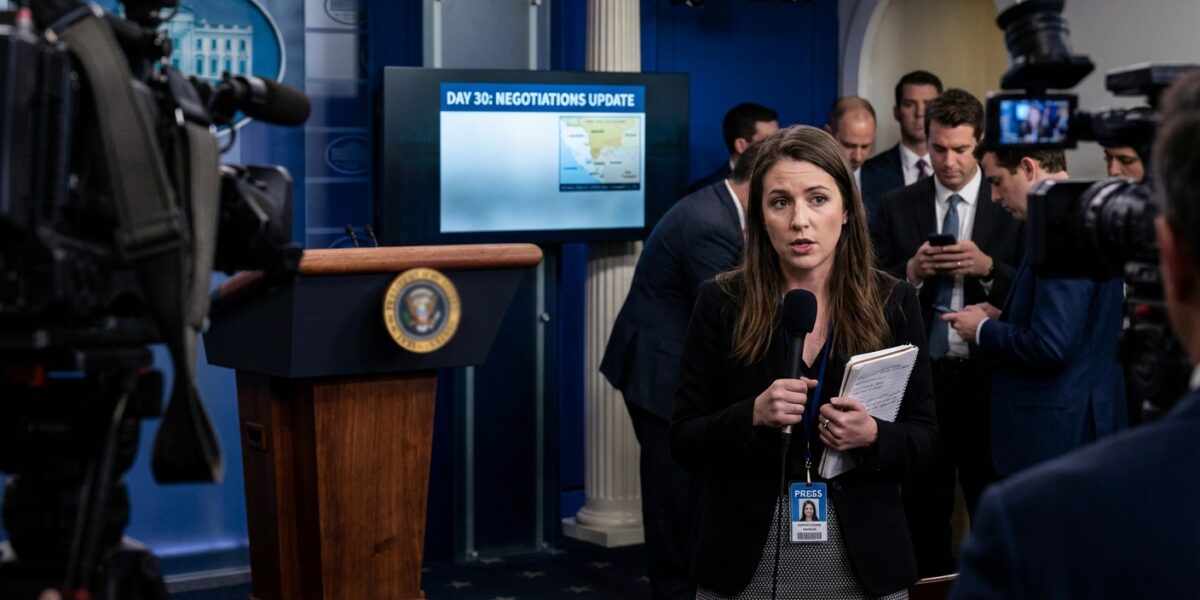
The United States has a 15-point peace plan. Iran has a 5-point peace plan. Pakistan is facilitating. Turkey, Egypt, and Saudi Arabia are supporting. The U.S. says Iran agreed to most of the 15 points. Iran says the 15 points are excessive, unrealistic, and unreasonable, and that it did not agree to any of them, and that it has not spoken directly with the United States. The U.S. says there have been talks both directly and indirectly. Iran says there have been no direct talks and that messages through intermediaries do not constitute talks. The oil is at $116 a barrel. It has been thirty days.
Trump, asked on Air Force One about Iran’s agreement to the 15 points, said: “They gave us most of the points. Why wouldn’t they?” This is a complete sentence that contains a confident assertion and a rhetorical question whose answer, per the Iranian Foreign Ministry’s Monday press conference, is: because they haven’t agreed to them and also haven’t been in talks. Iran’s spokesperson Esmaeil Baghaei said the 15-point proposal included requests that Iran found “largely excessive, unrealistic, and unreasonable” — a description that covers approximately 15 of the 15 points, though which 15 remains unspecified since no official text has been published and neither the White House nor NPR nor anyone else has confirmed what is actually in the plan.
Iran, meanwhile, has issued its own five-point plan, which includes: ending aggression and assassinations by the U.S. and Israel, payment for war damages, and a guarantee of Iran’s sovereignty over the Strait of Hormuz. The U.S. 15-point plan includes, per what has been reported, Iran opening the Strait of Hormuz — which is also on Iran’s five-point plan, but on Iran’s list it is characterized as something Iran maintains sovereignty over rather than something Iran surrenders access control of, which is a difference in framing that Patricia considers the diplomatic equivalent of two people agreeing that a door exists while disagreeing about whose door it is.
The Accounting, Which Patricia Is Doing Because Someone Has To
The U.S. has 15 points. Iran says the points are unreasonable. Trump says Iran agreed to most. Iran says it didn’t. Iran has 5 points. The U.S. has not publicly responded to the 5 points. There are therefore currently 20 points on the table across two documents, with approximately 0 to 15 agreed upon depending on which party is issuing the statement, and the current diplomatic reality exists somewhere in the range between those two numbers.
Pakistan said it is prepared to host talks “in coming days.” Iran’s parliament speaker called the Pakistan initiative a cover for a ground invasion and said Iranian forces were “waiting for the arrival of American troops on the ground.” The USS Tripoli arrived in the region Friday with 3,500 U.S. service members. An additional 2,500 are on their way. Trump told the Financial Times that his “favorite thing” would be to take Iran’s oil. He also said Iran had provided “20 boatloads of oil” to prove seriousness. The 20 boatloads were to begin shipping Monday, which is today. Patricia is watching the Strait.
Trump also said, en route to Joint Base Andrews on Sunday, that he was negotiating with Iran “directly and indirectly” and that it was going “extremely well” before adding: “you never know with Iran because we negotiate with them and then we always have to blow them up.”
Patricia Unnamed-Source would like to note, for the record, that this sentence — “we negotiate with them and then we always have to blow them up” — was said by the President of the United States about the country with which he is simultaneously describing extremely productive negotiations, and that she is filing it verbatim because no restatement could improve it, and that her confidence level on today’s article is 15%, which is the number of points in the plan, and which she considers both a coincidence and an accurate assessment of the information environment on day thirty.
The Five-Day Deadline, Which Has Become A Ten-Day Deadline, Which Has Become The Current Situation
The original 48-hour Strait of Hormuz ultimatum became a five-day pause. The five-day pause became a ten-day extension to April 6. The ten-day extension is currently active. Within the ten-day extension, there are 15 points and 5 points and 20 boatloads of oil and a possible seizure of Kharg Island and 5,000 arriving troops and Pakistan’s hospitality and Iran’s denial that any of this is happening the way the other side describes it.
April 6 is one week from Monday. The five-day clock, the ten-day clock, and the 15-point plan are all running simultaneously. The 5-point plan is also on the clock. The Strait is partially open — Trump said Iran agreed to let 20 tankers through as “a sign of respect.” Iran has not confirmed this. The tankers are either moving or they are not, and by the time this article is published, the answer may be visible from satellite imagery, which is how Patricia expects to learn about it, because the official statements from both sides are currently describing different physical realities and one of them involves tankers that are either there or not there on a body of water that does not have a press office.
Gerald the houseplant reviewed the 15 points. Gerald also reviewed the 5 points. Gerald had notes on neither. Gerald’s confidence level is not available but his position has not changed in two years, which puts him ahead of most parties in this negotiation on the dimension of positional consistency.
Patricia Unnamed-Source, Washington Bureau, has now covered thirty days of this war. Her confidence level is 15% — the number of points in the plan — and she has 11 fake sources because the official record is currently doing the work of fake sources on its own and she didn’t want to crowd the field. All quotes are verbatim from Air Force One and Tehran press conferences. The 20 boatloads of oil are either shipping today or they are not. The Strait is open to enemies or it isn’t, depending on Iran’s definition. April 6 is the deadline. More to follow.