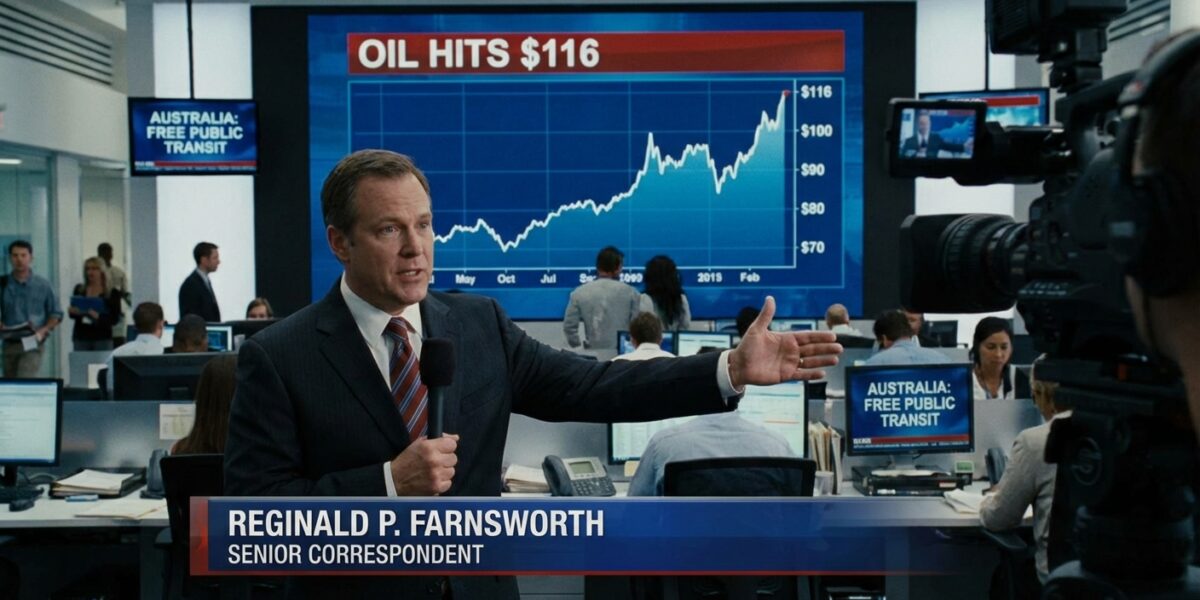
DUBAI / WASHINGTON — The biggest oil shock in the history of the International Energy Agency’s records is currently in progress, Brent crude is at $116 a barrel — up approximately 60% since the war began thirty days ago — and the President of the United States told the Financial Times on Sunday that his preference would be to “take the oil” in Iran and that seizing Kharg Island, which processes 90% of Iran’s crude oil exports, was under active consideration.
“Maybe we take Kharg Island, maybe we don’t,” Trump said. “We have a lot of options.”
“I don’t think they have any defense,” he added. “We could take it very easily.”
Experts disagree with the last sentence. Kharg Island is approximately 15 miles off Iran’s coast, in the northern Persian Gulf, within artillery range of the Iranian mainland. Getting an amphibious invasion force there would require transiting the Strait of Hormuz — the waterway that is currently the subject of a 15-point peace plan precisely because it is not reliably open — and most of the Persian Gulf. Iran has missiles, drones, and the stated intention to “set fire” to any U.S. troops that land on Iranian territory. “This is a case where we’re talking about a military mission in search of a strategic rationale,” one defense analyst told NPR. “What are we getting in exchange for doing this?”
The answer Trump provided to the Financial Times was: the oil. The oil is the strategic rationale. “To be honest with you, my favorite thing is to take the oil in Iran,” he said, comparing the approach to Venezuela, where the U.S. aims to control the oil sector “indefinitely.”
Reginald P. Farnsworth, Senior Correspondent, has covered economics for Supposedly News since the publication launched and would like to note that “favorite thing” is a category that Reginald has encountered in restaurant menus, personality quizzes, and Sound of Music lyrics, and that he has not previously encountered it in the geopolitical literature as a framework for evaluating military options in a live conflict with active artillery range considerations.
The Oil Situation, Stated In Numbers
At the start of the war, Brent crude was approximately $72 a barrel. It is now $116. This is a 61% increase in thirty days. The IEA — the International Energy Agency, which exists precisely to track these situations — has said the Strait of Hormuz closure constitutes the biggest oil shock in recorded history, surpassing the 1970s oil crises and the Ukraine war combined. The world is losing up to 20 million barrels per day from Middle East producers due to Iran’s selective blockade. Global energy markets are, to use the technical term, not doing well.
The responses to this from around the world are instructive. The United States eased sanctions on Russia and Venezuela to unlock alternative oil sources. Australia is making public transit entirely free in two states — Victoria through April, Tasmania through July 1 — to reduce dependence on fuel that now costs significantly more than it did a month ago. Western Australia reported a massive spike in public transit ridership as petrol prices soared. These are the downstream effects of the oil shock: free buses in Tasmania and a 61% price increase because a 15-point plan and a 5-point plan have not yet produced one agreed-upon point.
Into this context, the President of the United States told the Financial Times that his favorite thing would be to take Iran’s oil. Reginald is not going to characterize this strategically. Reginald is going to note that Kharg Island, if seized, would be the primary target of every Iranian missile, drone, and artillery piece in range, would require sustained U.S. military presence on Iranian territory, would invite retaliatory strikes on oil infrastructure throughout the Gulf — which would raise the $116 oil price considerably further — and that the defense analysts Reginald has read describe it as a mission currently in search of a reason rather than a strategy currently in search of execution.
The Venezuela Comparison, Which Is There
Trump compared the proposed Iran oil seizure to the U.S. approach to Venezuela, where he said the U.S. aims to control the oil sector “indefinitely.” Venezuela’s oil sector is currently producing at a fraction of its historical capacity after decades of sanctions, mismanagement, and political instability. The comparison is documented. Reginald is filing it as documentation and not commentary, because the documentation is the commentary.
Oil markets this morning are up 3.5% on news of Trump’s Kharg Island comments. This is the correct market response to the prospect of military action on the facility through which 90% of Iran’s oil exports travel: the oil that is already 60% more expensive got more expensive, because the option to make it significantly scarcer was raised by the person who controls the military capable of making it scarcer.
The 20 boatloads of oil Iran agreed to send through the Strait as a “sign of respect” are reportedly shipping today. The Strait otherwise remains subject to Iran’s selective blockade. The peace plan has 15 points plus 5 points and zero agreed-upon points. The oil is at $116. Tasmania has free buses. Reginald has done the math. The math says April 6 is a significant date, the oil will move based on what happens before then, and the preferred option of the President of the United States is to take the oil, which would make all of the above numbers larger and Australian transit free for longer.
Reginald P. Farnsworth, Senior Correspondent, filed this piece on day thirty of his coverage of the war and the associated oil shock. Confidence: 24% — the date. Fake sources: 6. All price figures are from CNN and CNBC. The IEA oil shock designation is documented. The free transit programs in Australia are documented. Trump’s ‘favorite thing’ quote is verbatim from the Financial Times via CNBC and Military.com. The ‘mission in search of a strategic rationale’ quote is from NPR. Gerald the houseplant does not use gasoline. Gerald’s operating costs have not changed. Gerald is the most energy-efficient entity in this story.