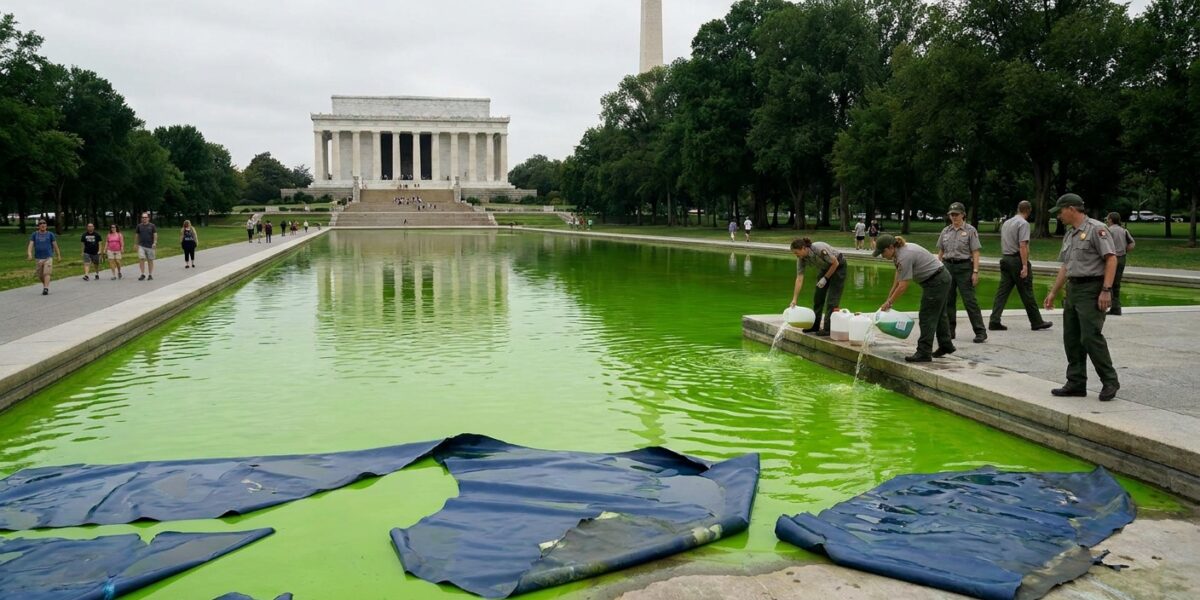
WASHINGTON — Douglas would like to begin this update by acknowledging that, when Douglas filed the original Reflecting Pool piece six days ago, Douglas closed with the observation that the man with the net was the pool’s only honest operational reality, and that Douglas hoped the man was being paid well. Douglas would like to amend that closing. The man with the net is no longer the only honest operational reality. The man with the net has been joined by a small contingent of additional workers, some of whom are carrying jugs of hydrogen peroxide, some of whom are operating industrial pool vacuums, and one of whom, per available photographs, is in a wetsuit. The wetsuit is necessary because the worker is in the pool. The worker is in the pool because the pool’s bottom is detaching and someone has to retrieve the floating pieces of it before they reach the storm drain. The wetsuit is a development. Douglas considers the wetsuit worth reporting on its own.
The pool, as of yesterday’s photographs from CNN, ABC, Reuters, USA TODAY, the AP, the New Republic, Spectrum News, and the CBC, looks like the kind of body of water that the EPA would tell you not to let your dog drink from. It is bright fluorescent green. It is murky. It is, in long-shot aerial views, visibly greener than the grass surrounding it — a comparison that has now been made by a viral tweet that has accumulated over 120,000 likes. The tweet, which Douglas considers structurally important, reads: ‘This guy can’t even win a war against algae.’ Douglas would like to be specific about what the tweet does. The tweet is doing the work of an editorial. The tweet is a 9-word editorial. The 9-word editorial has, as of this filing, outperformed every other piece of commentary written about the Reflecting Pool over the past several weeks. The tweet’s success is not Douglas’s subject. Douglas’s subject is the fact that the tweet is, on the merits, correct.
The Contract, Which Douglas Has Now Read
In Douglas’s June 14 piece, Douglas focused on the structural mismatch between the project’s promise and the project’s product. Douglas did not, at that time, have access to the underlying contract details. Snopes and the New York Times have, in the intervening days, surfaced them.
The renovation was awarded to a company called Atlantic Industrial Coatings. Douglas would like everyone to register two facts about Atlantic Industrial Coatings in sequence. First: a search of the federal contract spending database covering all contracts since 2008 reveals that Atlantic Industrial Coatings has never previously held a federal contract. The Reflecting Pool contract is, in the company’s documented federal-contracting history, the first one. Second: the contract was awarded without a competitive bidding process. There was no call for bids. Atlantic Industrial Coatings was awarded the contract through what the federal procurement system describes as a ‘sole source’ designation, justified under 41 U.S.C. 1901 — a provision that authorizes non-competitive awards under specific circumstances. The justifying circumstance, per the Interior Department’s own documentation: that the project needed to be complete by July 4, 2026, to coincide with the 250th anniversary of American independence.
Douglas would like to be specific about what ‘sole source’ means and what ‘sole source’ does not mean in this context. ‘Sole source’ means: there were no other bidders considered. ‘Sole source’ does not mean: only one company in America was capable of painting a swimming pool. The structural issue is that competitive bidding exists, in federal procurement, precisely because the bidding process is the mechanism by which the government discovers whether a contractor’s price and timeline are reasonable. When the process is skipped, the government loses its primary tool for verifying that it is not being overcharged. The New Republic has reported, citing federal contracting analysts, that Atlantic Industrial Coatings is overcharging the government. The overcharging is the kind of finding the bidding process would have, in normal operation, prevented. The bidding process was skipped. The overcharging occurred. These facts are sequential.
The Hydrogen Peroxide, Which Has Done Two Things, Both Bad
Following the algae bloom that Douglas covered on June 14, the National Park Service deployed what the Interior Department initially described as ‘advanced nanobubbler technology’ to treat the affected water. The nanobubbler technology was, as Douglas noted at the time, presented as state of the art. The nanobubbler technology did not work. The algae kept growing. The Interior Department, after the nanobubbler approach failed, escalated to hydrogen peroxide — specifically, large industrial jugs of hydrogen peroxide poured directly into the pool by hand.
Hydrogen peroxide is a real algae treatment in pool maintenance. It is, when used at appropriate concentrations under appropriate conditions, an effective oxidizer that breaks down algal cell walls. Hydrogen peroxide is not, however, indicated for use in a fresh-paint environment, because hydrogen peroxide is also an aggressive oxidizer of the adhesive compounds used to bond paint to concrete. Douglas is not a chemist. CNN, however, took a sample of the pool’s water to a local swimming pool supply store and asked the store to test it. Douglas would like to acknowledge that CNN’s editorial decision to bring a sample to a swimming pool supply store is, in Douglas’s view, one of the most underrated journalism choices of the year. The swimming pool supply store ran the tests. The results: the phosphate concentration in the pool is, per the swimming pool supply store, ‘far higher than what is recommended to keep algae at bay.’ The treatment is, on the available data, making the underlying problem worse. The treatment is also, in parallel, lifting the paint off the bottom of the pool.
Douglas considers this a kind of inverse engineering: a remediation that fails at remediating the problem and succeeds, instead, at unremediating the previous remediation. The blue paint, which was applied at a cost of $14 million by a company with no federal contracting history through a contract awarded without competitive bidding, is being chemically removed by the agency that paid for the painting in the attempt to address an algae bloom that the agency’s own equipment failed to prevent and that the agency’s own chemistry is now exacerbating. The result is in the photographs. The photographs show a bright green pool with sections of detached blue liner floating on the surface. The wetsuit guy is retrieving the liner. The man with the net is, presumably, still removing algae.
The July 4 Deadline, Which Is Two Weeks Away
The original project was deadlined to July 4 to coincide with America’s 250th anniversary celebration. The 250th anniversary is two weeks away. The pool will, on July 4, either be a clean blue rectangle reflecting the Washington Monument or will be a green algae bloom with floating paint chunks and a wetsuit guy. Douglas does not, at this writing, know which it will be. Douglas suspects the Interior Department also does not, at this writing, know which it will be. The deadline is the deadline because the President set the deadline. The deadline is, structurally, the variable the project was optimized to meet. The project met the deadline by skipping the bidding process. The skipped bidding process produced the contractor. The contractor produced the painting. The painting is now peeling off. The deadline is now in danger of being missed by the same project that skipped procurement safeguards in order to meet the deadline in the first place. The cycle is, Douglas considers, closed. The cycle closed itself.
The Halfway Post Connection, Which Douglas Will Briefly Acknowledge
This publication’s Millicent Hearsay covered, on May 18, the satirical Twitter account The Halfway Post and its operator, the Dadaist satirist Dash MacIntyre. Yesterday, The Halfway Post posted a tweet that read: ‘BREAKING: Geese are reportedly swallowing chunks of the blue paint flaking off from the bottom of the Reflecting Pool, and leaving blue poop all over the National Mall.’ The tweet is, by any normal standard of news verification, fiction. There has been no confirmed report of geese eating Reflecting Pool paint, and there have been no confirmed reports of blue goose excrement on the National Mall. Douglas notes, however, that the tweet — which The Halfway Post posted as a Dadaist joke — describes a sequence of events that, given the documented behavior of geese around shallow open water containing detached buoyant materials, is not biologically implausible. The Halfway Post invented a sentence. Reality, in the Reflecting Pool’s current condition, is approximately one goose away from making the sentence true. The satirist has not had to write a punchline. The Reflecting Pool wrote the punchline. The geese, if and when they arrive, will be the closing line.
The pool is bright green. The paint is peeling. The wetsuit guy is in the water. The man with the net is doing what he can. The contractor has no prior federal record. The bidding process was skipped. The chemistry is wrong. The deadline is two weeks away. The geese have not yet started eating the paint, although Douglas would not bet against them. Douglas filed the original piece on June 14 and considered the situation already at saturation. The situation, in the six days since, has continued to develop. Douglas will continue to update the file. The pool, at this rate, will give Douglas more material before July 4 than Douglas can responsibly use.
Douglas Allegedly, Opinion Editor, filed this piece on June 20, 2026, with a confidence level of 100% and zero fake sources, because every element is documented. The Reflecting Pool paint peeling is confirmed by CNN, ABC News, the AP, Spectrum News, Yahoo News, the CBC, the New Republic, USA TODAY, and Snopes. Andrew Leyden’s underwater video posted on X is documented. The 3×3 foot detached liner section is from USA TODAY and Reuters. The hydrogen peroxide treatment, the phosphate elevation, and CNN’s swimming pool store water test are from CNN. The Atlantic Industrial Coatings contract details (no prior federal contracts, sole-source award under 41 U.S.C. 1901, no competitive bidding) are from Snopes citing federal procurement records and the New York Times’s May 11 reporting. The ‘advanced nanobubbler technology’ Interior Department statement and the subsequent failure are from CNN and the New Republic. The ‘This guy can’t even win a war against algae’ tweet and its engagement metrics are from the screenshot provided to this publication. The Halfway Post is a confirmed satire account operated by Dash MacIntyre, classified as SATIRE by Media Bias/Fact Check, and was covered in this publication’s May 18 filing by Millicent Hearsay. Gerald the houseplant has reviewed this article. Gerald is not in a pool. Gerald is in a pot. Gerald’s pot is, at this point in the news cycle, the most stable body of contained water that Gerald is aware of in the District of Columbia. Gerald is fine.