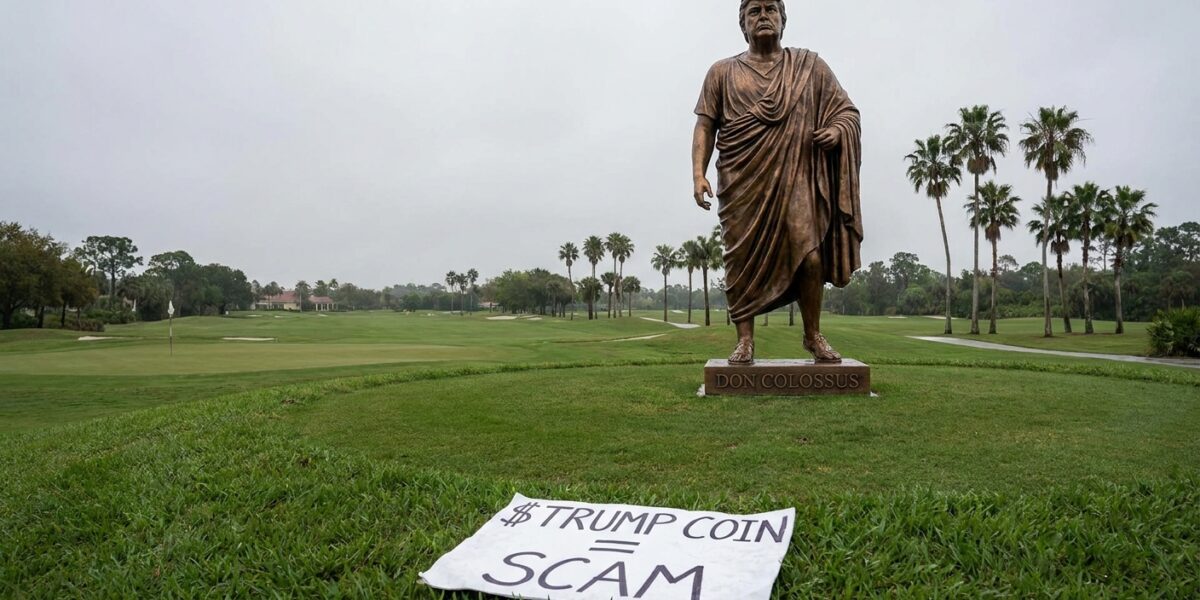
WASHINGTON — Douglas maintains a file. Readers of this publication know the file. The file is labeled, in Douglas’s private organizational system, ‘Founding-Era Numerology,’ and it contains every documented instance of the current administration and its aligned financial ecosystem branding a money vehicle with a number drawn from the American founding.
The file’s existing entries, briefly. Entry one: the Anti-Weaponization Fund, established in the May 19 IRS settlement that Chad Exposé covered — the fund into which the IRS payment was directed was sized at $1.776 billion, a figure that serves no actuarial purpose and one rhetorical purpose, which is to spell 1776 with a dollar sign and a decimal point. Entry two: 1789 Capital, the venture firm co-founded by Donald Trump Jr., which financed the Enhanced Games that Yolanda Tippington covered in May — named for the year the Constitution went into effect. Entry three: the $PATRIOT memecoin, which funded the 22-foot gold-finished Don Colossus statue at Trump National Doral, covered by Douglas himself, in the piece where Pastor Mark Burns stood in front of a golden statue and announced, ‘this is not a golden calf.’ Douglas’s consistent analytical position, across all three entries, has been that the numerology is marketing — that the founding-era numbers are deployed to borrow the moral authority of 1776 and lend it to instruments that are, underneath the wrapping, ordinary vehicles for moving money toward the people who issue them.
Douglas stands by that analysis. Douglas is filing today because the file has received a new entry, and the new entry was not submitted by the administration, or by a venture firm, or by a memecoin promoter. The new entry was submitted by the market.
The Entry, Which Douglas Will Now Read Into The Record
The $TRUMP memecoin launched on January 17, 2025, three days before the inauguration, promoted by the President personally. It peaked, two days later, at $75.35. It has since lost 97 percent of that value. Per the New York Times, per Nansen, per Raw Story, per The Block, per every outlet that has carried the figure, the coin now trades at $1.76.
Douglas would like the reader to look at that number the way Douglas looked at it, which was for a long time, in silence. One dollar and seventy-six cents. The coin that belongs to the genre of founding-era numerology — the genre of the $1.776 billion fund, the genre of 1789 Capital, the genre of $PATRIOT — has been repriced by the open market to the founding year itself, decimal shifted, to the penny. The marketing said 1776. The market said $1.76. The market, which does not read press releases and does not care about branding, arrived — through the independent, uncoordinated decisions of 1.48 million wallets buying and mostly selling — at the one price that completes the joke the branding started. Douglas wants to be scrupulously clear, because Douglas’s credibility rests on this kind of clarity: the $1.76 price is a coincidence. Markets do not do numerology. The price is the mechanical output of supply meeting demand at a moment in time, and tomorrow it will be some other number. Douglas is not asserting cosmic intent. Douglas is asserting something better than cosmic intent, which is that when you brand enough financial instruments with founding-era numbers, the laws of probability will eventually hand you a founding-era number you did not choose, at a moment you would not have chosen it, attached to a meaning you would never have approved. The administration spent a year telling the public that its money was 1776. The market waited, patiently, and then priced the money at $1.76 — down 97 percent — and in doing so filed the most concise piece of financial commentary of the year. Douglas has read the analysts. None of them said it this efficiently. The ticker said it in four characters.
What The Golden Calf Piece Was Actually About, Which Is What This Is Actually About
When Douglas wrote about the Don Colossus in May — the statue, the pastor, the ‘this is not a golden calf’ — Douglas made a distinction, borrowed from the theologians, between latria and dulia: between the worship owed to God alone and the veneration permitted toward lesser things. Douglas argued that the Exodus story’s warning was never really about statues. It was about what happens when a people, feeling anxious and leaderless, pool their gold into an object and assign the object a power it does not have. The gold does not become divine. The gold just becomes concentrated. Somebody ends up holding it. In Exodus, the calf is ground into powder. In the memecoin version, per Nansen’s ledger: 988,905 people pooled $3.81 billion of their gold into the object, the object’s price was ground into powder — 97 percent of it — and the man whose image was on the object walked away with $636 million, because the object’s design paid him a fee every time anyone’s faith in it changed hands, in either direction.
Douglas would like to note the structural continuity between the statue and the coin. The $PATRIOT memecoin funded the Don Colossus: a memecoin buying a golden image. The $TRUMP memecoin was, in a sense, the same transaction run in reverse and at national scale: a golden image selling a memecoin. In both cases the underlying mechanism is identical — the conversion of political devotion into a financial instrument whose fees flow to the object of the devotion. The theologians had a word for charging money for sacred things; the word is simony, and Douglas has been waiting all year for an occasion to use it in a filing, and Douglas judges that a coin bearing a leader’s image, promoted as ‘everything we stand for,’ structured to collect a toll on every act of purchase and every act of abandonment, has earned the word. The buyers were not investing. The disclaimers said so themselves — the coin’s own website described the tokens as an ‘expression of support’ rather than an investment. Millicent Hearsay is filing separately today on that phrase, and Douglas will not poach her material. Douglas will say only this: the file is updated. The numerology thread that began with $1.776 billion now ends, for the moment, at $1.76. The wrapping said 1776. The contents said $1.76. The gap between the wrapping and the contents is $3.81 billion, and it is currently being held by roughly half a million early wallets and one man in Washington whose name was on the wrapper. Douglas will keep the file open. The genre, Douglas suspects, is not finished. The genre never is. But the market has, this week, written the genre’s finest line, and Douglas — who writes structural analysis for a living — knows better than to try to top it. One dollar. Seventy-six cents. File closed on the entry. File open on the era.
Douglas Allegedly, Opinion Editor, filed this piece on July 4, 2026, with a confidence level of 100% and zero fake sources, because every element is documented. The $TRUMP memecoin’s $1.76 trading price, $75.35 peak, and 97% decline are from the New York Times via Raw Story, The Block, Mediaite, and Blockchain Reporter. The Nansen loss and gain figures are from the Times via The Block and Gizmodo. The $636 million presidential payout is from the President’s annual financial disclosure via the Times. The ‘expression of support’ website disclaimer is documented by Bitcoin.com News. The $1.776 billion Anti-Weaponization Fund is from this publication’s May 20 filing and is confirmed by NPR, CNN, and NOTUS. 1789 Capital’s backing of the Enhanced Games is from NPR and KPBS via this publication’s May 27 filing. The $PATRIOT memecoin and Don Colossus statue are from this publication’s May 18 filing, confirmed by Snopes. Pastor Mark Burns’s ‘this is not a golden calf’ quote is documented. The theological terms latria, dulia, and simony are used in their standard historical senses. The coincidental nature of the $1.76 price is explicitly acknowledged in the text; Douglas asserts probability, not providence. Gerald the houseplant has reviewed this article. Gerald’s value has never fluctuated. Gerald was worth one houseplant at the start of the year and is worth one houseplant today. Gerald is, by the standards of this news cycle, the strongest-performing asset in the building. Gerald is fine.