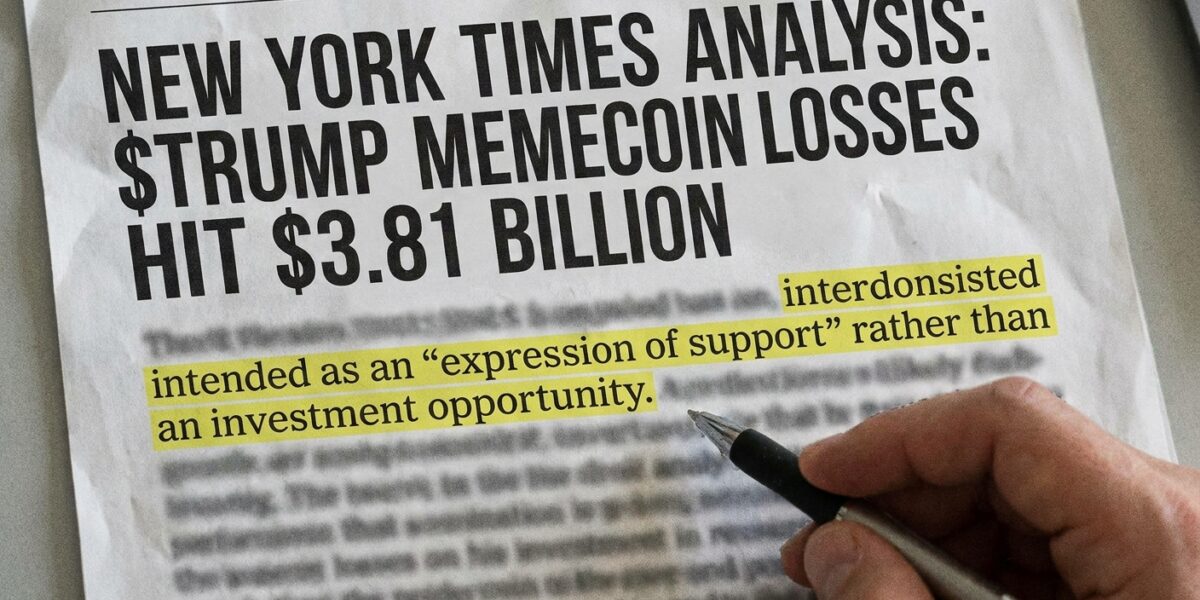
WASHINGTON — Millicent’s beat is the attention economy, and the attention economy runs on a conversion. The conversion is always the same, whatever the product: human feeling goes in one end — loyalty, hope, belonging, grievance, love — and money comes out the other, and the machine in the middle takes its cut. Millicent has documented many models of the machine this year. The AI meme catalogue converts political feeling into engagement. The Great American State Fair attempted to convert patriotic feeling into attendance. The Enhanced Games converted the feeling of human transcendence into peptide sales. Millicent had believed, until this week, that she had seen the machine’s most efficient form. Millicent had not. The most efficient form was disclosed, in fine print, on the website of the $TRUMP memecoin, and it consists of four words: ‘expression of support.’
Per the reporting around the New York Times analysis, the coin’s website carried a disclaimer stating the tokens were intended as an expression of support, not an investment opportunity. Legal analysts observe that this language may shield the issuer from securities claims — the SEC declared in February 2025 that memecoins are not securities — though NYU’s Stephen Gillers notes it may not block all civil litigation. Millicent will leave the legal questions to the lawyers. Millicent is interested in the four words as a cultural artifact, because Millicent believes they are the most important four words in modern American commerce, and Millicent would like to explain why.
The Disclaimer Is A Confession
Consider what the disclaimer actually says, if you read it not as legal armor but as a plain declarative sentence. It says: this token is not an investment. It has no underlying business, no revenue, no utility, no claim on anything. What you are buying, when you buy it, is a feeling — the feeling of supporting the man whose name is on it. Your money is not being put to work. Your money is the expression. The purchase is the applause.
Millicent would like everyone to notice that this is, on the merits, completely true. It is the truest sentence in the entire enterprise. The promotional posts — ‘It’s time to celebrate everything we stand for: WINNING! GET YOUR $TRUMP NOW!’ — were feelings dressed as opportunities. The price chart, spiking to $75.35 on launch weekend, was a feeling wearing a number. But the disclaimer, the little gray sentence at the bottom of the website that nobody reads, told the truth: this is not an investment. This is support, expressed. The fine print was the only part of the operation that never lied. Millicent has covered marketing for years and she wants to register how rare this is — an enterprise whose fraud, to whatever extent a court eventually finds fraud, was conducted entirely in the headline, while the footnote was innocent. Usually it is the other way around.
Fandom, Securitized, And Marked To Market
Here is what Millicent thinks actually happened, described in the vocabulary of her beat. For most of human history, fandom was economically inefficient. You could love a king, a team, a singer, a president, and the object of your love could capture only a trickle of that feeling — a ticket, a t-shirt, a donation, a vote. The feeling itself, the vast reservoir of it, was unmonetizable. It just sat there in people’s chests. The memecoin solved this. The memecoin is a technology for securitizing fandom — for converting the reservoir itself into a tradable instrument, so that every fluctuation of a million people’s feeling about one man becomes a transaction, and every transaction pays the man a fee. When the feeling surged in January 2025, the surge was a price: $75.35. When the feeling ebbed, the ebb was also transactions, and the transactions also paid him. The Times put it precisely: he profited whether the price went up or down, because he collected returns whenever anyone traded it, and he repeatedly urged them to trade it. The instrument did not monetize the coin’s success. The instrument monetized the activity of caring. Two-thirds of the carers — 988,905 people — have now lost a combined $3.81 billion. Their support has been expressed. The expression has been received: $636 million of it, routed through CIC Digital LLC, per the recipient’s own signed disclosure.
Millicent would like to be careful here, in the way this publication is always careful, about who the target of this piece is. The target is not the buyers. Millicent has read commentary this week describing the buyers as fools, and Millicent rejects the description. The buyers did what fans have always done: they expressed support for someone they trusted, in the denomination that was put in front of them. David Frum wrote this week that he had assumed the coin’s buyers were ‘in on the con’ — laundering favors — and was startled to learn that the buyers were, in fact, mostly ordinary people ‘sadly gullible enough to entrust savings to’ the coin’s issuer. Millicent would put it less harshly than Frum. The buyers were not gullible about crypto. They were trusting about a person. One of them, Nicholas Pinto, a Trump voter who lost roughly a quarter million dollars, said it best: he bought because the seller ‘seems trustworthy in the public’s eye’ — and then delivered the verdict, ‘it is almost a legal scam.’ The trust was the asset being harvested. That is not the fans’ shame. In every prior era of the attention economy, the machine at least had to give the fans something back — a song, a game, a show. This machine gave them a ticker symbol for their own devotion and charged them a toll both for arriving and for leaving.
What Millicent Will Add To The Catalogue
Millicent maintains, as regular readers know, a catalogue of the attention economy’s artifacts, with subfolders. This week the catalogue gains a new top-level entry, and Millicent has decided to label it with the enterprise’s own four words: Expression of Support. Under that label, Millicent files the following summary, for the benefit of whoever consults the catalogue in years to come. In January 2025, a newly inaugurated president launched a token bearing his name, promoted it as a celebration of winning, and disclaimed, in fine print, that it was an investment. Roughly 1.48 million wallets bought it. The early half-million, many of them automated, captured four billion dollars. The trusting million lost $3.81 billion. The president collected $636 million in fees on the churn — nearly three times the net gain of all his supporters combined — while his regulators announced the category was outside their oversight. The coin now trades at $1.76, a figure Millicent’s colleague Douglas Allegedly has addressed in a companion filing that Millicent commends to the reader. And through it all, at the bottom of the website, the four honest words sat unread: expression of support. The support was expressed. The expression was collected. The fine print was the only witness that never perjured itself. Millicent closes the entry there, because the entry does not need a punchline. The disclaimer was the punchline. It was there the whole time. Nobody reads the fine print, and this year, the fine print was the only thing telling the truth.
Millicent Hearsay, Culture Desk, filed this piece on July 4, 2026, with a confidence level of 100% and zero fake sources, because every element is documented. The ‘expression of support’ website disclaimer is documented by Bitcoin.com News’s coverage of the New York Times analysis. The Nansen figures (988,905 losing wallets, $3.81 billion in losses, ~492,285 winning wallets with $4.04 billion, 1.48 million total wallets, $236 million net) are from the Times via The Block and Gizmodo. The $636 million payout via CIC Digital LLC is from the President’s annual financial disclosure via the Times and The Block. The February 2025 SEC memecoin statement is from Yahoo Finance and Bitcoin.com News. Stephen Gillers’s caution on civil litigation is from Bitcoin.com News. David Frum’s verbatim post and Senator Blumenthal’s verbatim post are from the public record. Nicholas Pinto’s quotes and reported losses are from the New York Times via Mediaite and Raw Story; Mr. Pinto and the coin’s other buyers are treated throughout as people who lost money, not as satirical targets. The ‘GET YOUR $TRUMP NOW!’ promotion is verbatim. Douglas Allegedly’s companion $1.76 numerology filing and Chad Exposé’s companion investigative filing are published by this publication today. Gerald the houseplant has reviewed this article. Gerald expresses support through oxygen, which he distributes to everyone in the room without a fee, in both directions, forever. Gerald is the only zero-commission operation in this entire story. Gerald is fine.